When You Keep Tweaking the Game but the Mood Doesn’t Change
“If Ye Keep Adjustin’ the Dials but the Room Feels the Same, Stop Fiddlin’ a Moment.”
You changed the encounter balance.
You shortened combat.
You added stronger hooks.
You introduced a more dynamic villain.
You even rewrote your session openings.
And yet…
The mood at the table hasn’t shifted.
Not worse.
Not explosive.
Just… unchanged.
If you’re constantly tweaking mechanics, pacing, or structure but the atmosphere feels stubbornly static, this isn’t about incompetence.
It’s about diagnosis.
Let’s dig into it.
The Tweak Trap
When something feels off, the natural instinct is:
“Adjust the system.”
So you:
Refine initiative flow.
Increase stakes.
Add cinematic narration.
Introduce new mechanics.
Change platforms or tools.
But mood isn’t always mechanical.
If your battles feel tighter but still emotionally flat, revisit When Every Battle Feels Like a Board Meeting With Dice.
Because tightening screws doesn’t fix disengagement.
Engagement isn’t just structure.
It’s ownership.
When the Real Issue Isn’t the Game
Here’s the uncomfortable possibility:
The table’s mood may not be reacting to mechanics at all.
It may be reacting to:
Uneven spotlight.
Passive players.
Over-cautious energy.
Unspoken tension.
Burnout (yours or theirs).
If you’ve been carrying the entire emotional tone yourself, you might recognize that weight in When You Feel Quietly Responsible for Everyone’s Fun.
Mood doesn’t change when responsibility isn’t shared.
It just stabilizes at “mildly fine.”
And mildly fine is exhausting.
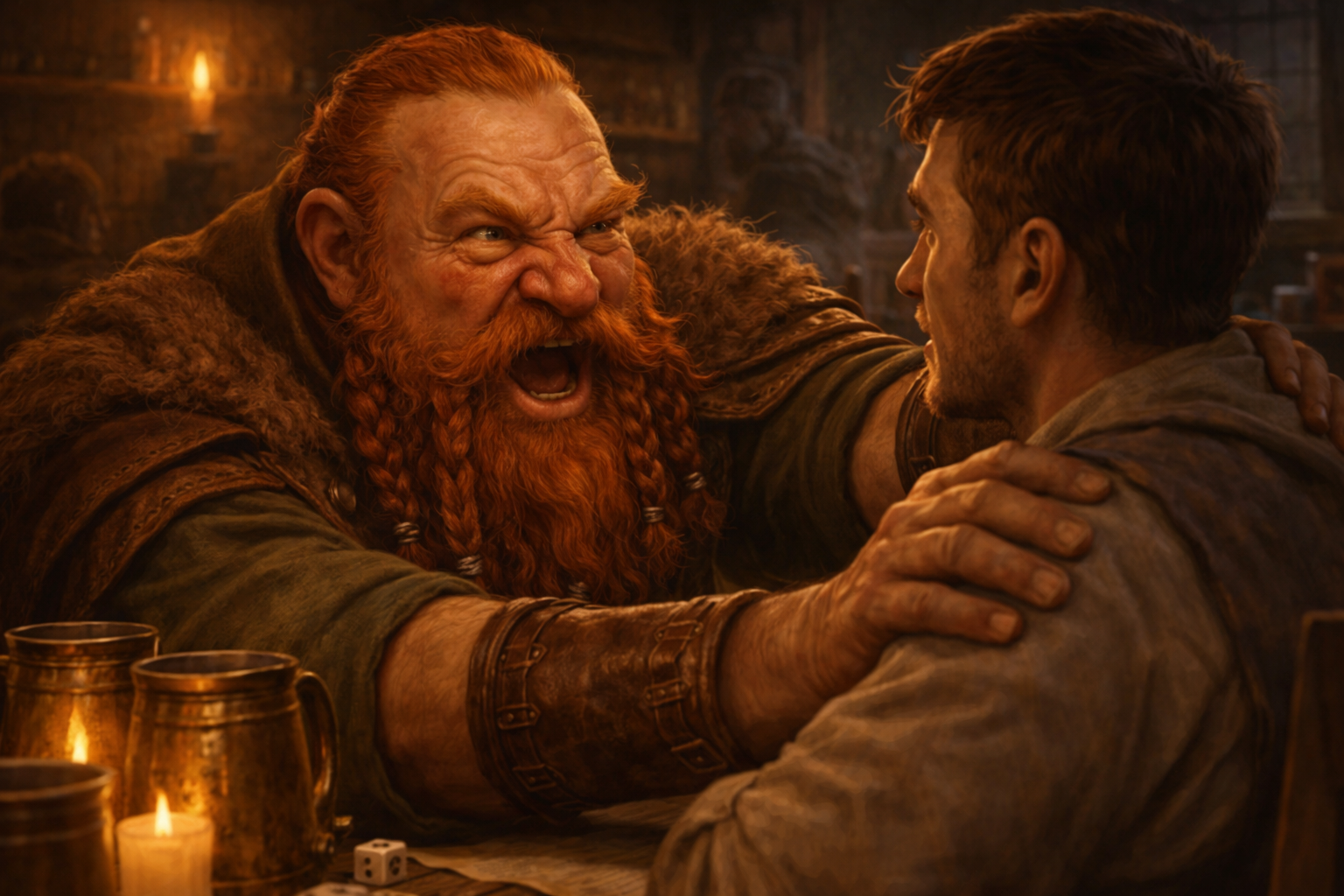
Mike Slams His Tankard on the Bar
Listen here, ya knob-twistin’, scroll-revisin’ gem-dropper.
By Harnak’s shattered pickaxe, if ye’ve adjusted initiative three times and rewritten yer villain’s monologue twice, and the table still feels like lukewarm stew — it ain’t the stew.
Ye can’t polish atmosphere with mechanics alone.
If the room’s quiet because folk are hesitant, no amount of damage optimization is fixin’ that.
If they’re coasting instead of investing, more prep won’t save ye.
I’ve seen GMs rebuild entire arcs when all they needed was one honest question at the table.
Stop fightin’ the symptom.
Find the source.
The Difference Between Structural and Social Problems
Before you tweak again, ask:
Are players initiating scenes?
Are they referencing past events?
Do they speculate about future arcs?
Are quieter players getting space?
If the answer is no, then your adjustments are likely aimed at the wrong layer.
For spotlight imbalance, revisit The Quiet Player vs the Table Hog — How to Keep Both Happy Without Losing Your Mind.
If the table feels full but oddly hollow, explore When the Table’s Full but It Feels Empty.
Mood stagnation usually points to social drift, not mechanical deficiency.
When You’re Adjusting Out of Anxiety
Sometimes the tweaking isn’t about improvement.
It’s about control.
You feel uncertainty.
You feel doubt.
You feel that subtle, unnameable dissatisfaction.
So you change something.
Because changing something feels productive.
If you’ve walked away from sessions unsure whether they were good or not, revisit When a Session Ends and You Can’t Tell If It Was Good or Not.
Mood stagnation often begins with self-doubt.
And self-doubt drives overcorrection.
Sometimes the Mood Is Stable — Not Stale
Here’s another angle most GMs miss.
What if the mood isn’t declining?
What if it’s steady?
Not every campaign feels explosive.
Some are:
Consistent.
Comfortable.
Quietly engaging.
If no one is disengaging, no one is withdrawing, and attendance is stable…
You might be fixing something that isn’t broken.
Before you redesign the campaign again, revisit Top 5 Ways to Up Yer GM Game Without Tearin’ the Whole Thing Down.
Improvement doesn’t always require innovation.
Sometimes it requires patience.
A Practical Reset
Instead of tweaking mechanics again, try one of these:
Ask players what they’re most excited about next.
Let them define one complication.
Invite midweek speculation.
Reduce prep and increase reaction.
Shift from architect to collaborator.
Mood changes when players feel ownership.
Not when GMs add more polish.
Quick Questions Before You Twist Another Dial
If mechanics are tighter but the vibe hasn’t changed, what does that mean?
The issue is likely social, not structural.
Should I keep tweaking until it improves?
No. Diagnose first. Adjusting blindly creates exhaustion.
How do I know if the mood is actually a problem?
Look for disengagement patterns — missed sessions, minimal input, lack of initiative. If those aren’t present, you may be overcorrecting.
And if you ever need to remind yourself what this tavern stands for, revisit About Mike’s Tavern.
If you’re trying to understand how these topics connect, the FAQ might help.
And if the weight behind the screen feels heavier than this page can hold, the Contact page is open.
More from Around the Tavern
Tools, Combat & Practical Craft