When Battlemaps Slow Combat Instead of Clarifying It

Battlemaps are supposed to make combat cleaner. Everyone sees the same room, the same distances, the same threats. No guessing, no arguing, no “wait, I thought I was behind cover.”
And yet.
Every table’s seen it happen. The map comes out, the minis hit the grid, and suddenly the fight slows to a crawl. Turns stretch. Players stare. Measuring starts. Debates pop up like mushrooms in a damp cellar. What should have been a fast, hungry scrap turns into a slow, careful negotiation.
This article is for the GM who’s sick of that feeling. Not because battlemaps are bad, but because battlemaps can become the reason combat dies when they’re used the wrong way.
If you’re new around here, start with About Mike’s Tavern, skim the FAQ, and if you want to ask something specific about your table, you can always reach me through the contact page.
The First Lie About Battlemaps
The lie is that maps automatically create clarity.
Maps create clarity when the table already agrees on the basics. When everyone understands the stakes, understands their options, and is willing to move. That’s when the grid feels like a clean tool.
But if your table is hesitant, perfectionist, anxious about making the wrong call, or quietly competitive about tactics, a battlemaps turns into an invitation to overthink. When the map is detailed, players stop picturing danger and start picturing optimization.
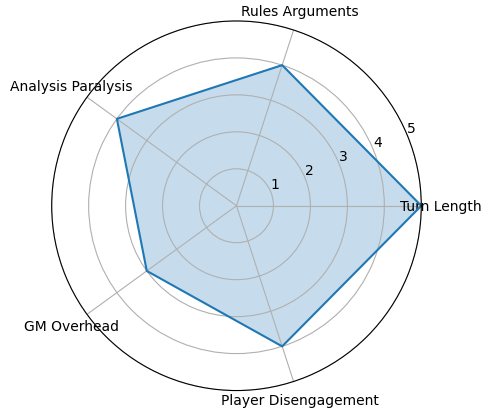
That’s why the charts you’re using in this series make sense. When battlemaps go wrong, the biggest spike is turn length, then come rules arguments and analysis paralysis, followed by player disengagement. The map did not clarify anything. It gave the table more to chew on than they could swallow.
If your fights keep feeling like a paperwork exercise, this problem is the same beast discussed in When Every Battle Feels Like a Board Meeting With Dice.
The Slow-Combat Warning Signs
You can feel it in the room before anyone says anything.
Players stop speaking in character. They start speaking in geometry. The emotional tone drains out. Turns become quiet. The energy drops, but nobody wants to be the one to say it, because they think it’s their fault for “not being tactical enough.”
Here are the warning signs that the battlemap is slowing combat instead of clarifying it.
The first warning sign is the question loop. Players keep asking the same questions with different words.
“Can I reach that?”
“Is that within range?”
“If I move here, do I provoke?”
“What if I do it like this?”
They are not looking for clarity. They are looking for safety.
The second warning sign is the perfect turn fantasy. Players take ages because they are hunting for the best move, not a good move. They are afraid of wasting their turn, and the map makes them feel like there is always a better answer hiding somewhere on the grid.
The third warning sign is micro-arguments. Not big rules disputes, but tiny friction that adds up.
“Do I have line of sight?”
“That corner is questionable.”
“You said the door was open.”
“That’s not where my mini was.”
A battlemap gives those arguments something physical to grab.
And the fourth warning sign is silent spectators. One or two players stop engaging because the fight no longer feels like a story. It feels like a puzzle they are not invited to solve.
When that happens, you’re not running a battle. You’re running a negotiation. If the table has trouble with taking up space or speaking up during tense moments, that silence tends to hit certain players first, and you’ll see it spill into the social layer of the group too. If that sounds familiar, Let the Quiet Player Speak Before I Cast Silence on Ya pairs well with this problem.
Mike Butts In
“By Grabgar’s hammer, I’ve seen more brave fights die on a grid than under dragon fire. Lads spend ten minutes starin’ at squares like the squares are gonna whisper the answer. Then they finally move one step and act like they just solved a prophecy. LISTEN, YA MILK DRINKERS. Yer fighter is bein’ stabbed. Yer cleric is panickin’. Yer wizard is about ta learn humility. MOVE OR GET MOVED.”
Why This Happens
Battlemaps slow combat for one main reason: they change how players think.
A map turns a fight into a visible problem. Some tables love that. Others freeze. When players can see every option, they feel responsible for picking the best one. They start treating their turn like a test. And the more they care about not failing, the longer they take.
This is not a player flaw. It’s a table culture issue.
If your table has learned that mistakes get punished socially, then battlemaps become a trap. People hesitate. They consult. They seek approval. They argue pre-emptively to avoid being blamed. That is why a safe table matters even in “tactical” games. You’ll see that principle laid out plainly in A Safe D&D Table Ain’t a Soft One, It’s Where Ya Can Fall and Still Be Caught.
THE TAVERN NETWORK
Still thinkin’ of that old game ya played a while back, me lad? Perhaps its time ya looked for another table, revive those good ol’ days.
How to Keep the Map Without Letting It Kill the Fight
You don’t need to throw battlemaps away. You need to change how you use them.
The fastest fix is to shift the table from “perfect play” to “clear intent.”
Before you let anyone measure, ask for intent in one sentence.
“What are you trying to accomplish this turn?”
Not “What action are you taking,” but “What are you trying to accomplish.”
This immediately moves players out of grid obsession and back into story logic.
Then resolve with the minimum needed precision. If the intent is clear, the mechanics become faster. If the intent is unclear, the map becomes an excuse to stall.
The second fix is to cap the decision window. Not harshly. Not like a drill sergeant. Just a gentle standard. If your table regularly stalls, tell them the truth kindly.
“We’re keeping turns snappy so combat stays exciting. If you’re unsure, take a reasonable action and we keep moving.”
Some GMs worry this makes them “less good.” It doesn’t. It makes them more effective. If you’ve ever felt pressure to perform like a famous GM, remember what’s said in You’re Not Matt Mercer, Lad, and That’s a Bloody Good Thing.
The third fix is to reduce map precision when precision is not the point. Not every fight needs grid-perfect accounting. If the encounter is meant to be fast, messy, and scary, consider switching to zones or rough distances even while still using a visual. The map can be a reference, not a courtroom document.
The Most Common Hidden Cause
Here’s the sneaky one: your map is doing too much work.
When the map is highly detailed, players start using it as the primary source of truth. They stop listening. They stop imagining. They stop moving with instinct. They become cautious, slow, and exacting.
This is why the best “map tools” aren’t always the most feature-packed ones. The best ones are the ones that keep you fast.
If you want the cleanest breakdown of which mapping tools keep momentum and which ones tempt overthinking, the most important resource is When Maps Collide: Owlbear Rodeo vs Roll20 vs 2 Minute Tabletop. Read that with your table’s habits in mind, not with your tech preferences in mind.
The Turn-Snappy Field Manual
If you only change one thing, change this: stop letting the map be the conversation.
You can keep battlemaps and still run fast, tense, cinematic fights if you do three things every session.
First, ask for intent before measurement.
Second, keep turns moving even when they are imperfect.
Third, treat the map like a tool, not a judge.
If your table’s been drifting into fatigue, frustration, or that creeping sense of “I’m doing too much,” take five minutes with When You Can’t Tell If You’re Burnt Out or Just Tired of Them. The way combat slows is often the way burnout starts.
The Real Test
Here’s the simplest test.
After a fight, ask yourself:
Did the battle feel like danger, or did it feel like deliberation?
If it felt like danger, your map served the game.
If it felt like deliberation, your map became the game.
And if you realize you’ve been trying to “prep your way out” of slow combat, that’s a painful loop. The harder you prep, the more the table expects the map to answer everything. The more it answers, the more they hesitate. If you’ve felt that spiral, When Yer Heart’s Givin’ Out But Yer Hands Keep Preppin’ is worth a read.
The Map Ain’t the Problem, the Moment Is
Battlemaps are brilliant when clarity and tactics are the point. They are deadly when speed and emotion are the point.
So use the map like a seasoned tavernkeeper uses a weapon on the wall. It’s there when it’s needed. It is not the centerpiece of every conversation.
If you want more fixes like this, keep browsing the tavern, and if you’ve got a specific table problem you want me to take a swing at, start with the FAQ and send the details through the contact page.
More Tavern Goodness For Ya!