When You Feel Invisible at the Table (And No One Seems to Hear Ya)
Alright. Sit down, me lad. Don’t skulk in the doorway like a goblin what’s lost his nerve.
I’ve seen that look before, the tight jaw, the half-raised hand that never quite finishes the motion.
Ye’ve got somethin’ to say, but every time ye lean forward, some louder fool barrels through like a cart with no brakes. And so ye pull back. Again. And again. Tell yerself it’s fine. Not worth the fuss.
Not worth slowin’ things down. By Grabgar’s hammer, I know that burn. I’ve stood in war halls louder than thunder and felt smaller than a cracked tankard. And here’s the part that stings — ye’re not angry enough to fight, and not comfortable enough to speak.
So ye sit there, noddin’, smilin’, boiling quiet. Don’t tell me ye ain’t. I can smell that kind of silence from across the room. And if ye keep swallowin’ it, lad, it won’t stay swallowed. It’ll turn bitter. Now sit still. We’re not here to whine about it …
…
…
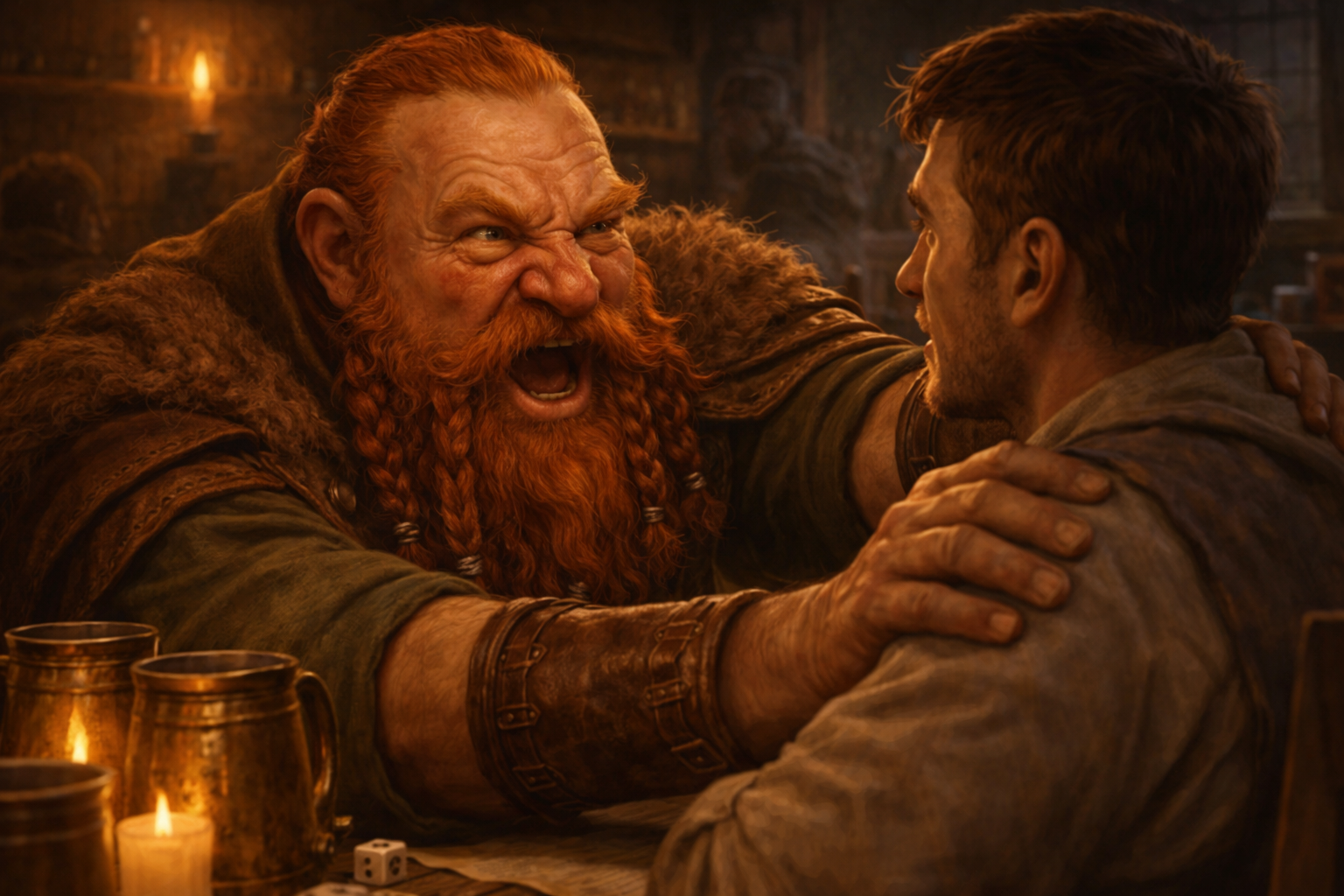
ARE YE LISTENIN’ TO ME, YA SMELLY HARPY?!
The Moment It Happens (Micro-Scene Breakdown)
Picture it.
The rogue pitches a plan. The wizard expands it. The bard riffs off it. Everyone’s laughing, building, escalating. You lean forward.
“I was thinking maybe we—”
The DM responds to the bard instead.
The conversation shifts.
Combat begins.
Your thought never lands.
You tell yourself it’s fine. Not worth interrupting. Not worth being “that player.”
So you go quiet.
You roll your turns. You nod. You smile.
Inside? Your temper’s running hot. But you don’t want to start a scene. You don’t want to derail momentum. So you clamp down.
And in doing so… you make yourself smaller.
That’s the part no one talks about.
The Pattern Beneath the Silence
This isn’t about volume.
It’s about conversational positioning.
At most tables, social gravity forms fast. Two or three dominant communicators unintentionally shape the airspace. Not because they’re cruel. Because they’re comfortable.
If you hesitate half a second, the space closes.
If you soften your tone, it gets absorbed.
If you wait for permission, it rarely arrives.
And over time, your brain learns something dangerous:
“Don’t try. It won’t matter.”
That’s how invisibility becomes habit.
If this feels familiar, you’ll want to read How to Handle Being Talked Over at the Table — it maps the mechanics of interruption clearly. And if you’re more reserved by nature, The Quiet Player’s Guide to Getting Noticed breaks down structural ways to shift your presence without becoming someone you’re not.
But today, we’re going deeper than mechanics.
We’re talking about resentment.
What Happens If This Continues (Long-Term Decay)
Session 1:
You shrug it off.
Session 3:
You start disengaging emotionally.
Session 5:
You stop pitching ideas entirely.
Session 8:
You wonder why you even show up.
Session 12:
You leave.
And the table says, “We didn’t know anything was wrong.”
Of course they didn’t.
You never told them.
You never trained them how to treat you.
And before you bristle at that — this isn’t blame. It’s leverage.
If you do nothing, the pattern calcifies.
If you adjust one behavior, the pattern shifts.
The Mike Ironbelly Reset — A Tactical Intervention Model
Here’s what you do next session.
Not louder.
Not aggressive.
Not dramatic.
Earlier. Firmer. Cleaner.
Instead of:
“I was thinking maybe we could…”
Say:
“Hold on — I’ve got something here.”
Pause.
Make eye contact with the DM.
Deliver your idea in one sentence.
Then stop.
No apology. No trailing tone.
You are not asking permission to exist.
You are claiming airspace.
If someone interrupts, calmly say:
“Let me finish, then I’m done.”
That sentence alone will rewire how people position you.
If you struggle freezing up, read How to Speak Up Without Freezin’ at the Table. It drills the timing piece specifically.
And if your table culture already leans toward steamrolling, this pairs well with The Strongest Character at the Table Is the One Who Listens — because listening is a trained behavior, not a personality trait.
But What If You’re Afraid of Causing Tension?
Ah.
There it is.
The real fear.
You don’t want to be difficult.
You don’t want to look needy.
You don’t want to derail the vibe.
Listen carefully.
Silence doesn’t protect harmony. It delays friction.
And delayed friction turns into private resentment.
If you’ve ever read When the Table’s Full but It Feels Empty, you know emotional disengagement kills campaigns faster than scheduling ever will.
You don’t fix invisibility by enduring it.
You fix it by calibrating your entry timing.
A Word From Mike Ironbelly (And Don’t Argue With Me)
By Durven’s last tankard, I’ve watched whole warbands crumble ‘cause one dwarf kept quiet too long.
Ye sit there, jaw tight, thinkin’, “It’s not worth it.”
NOT WORTH IT?!
Lad, if yer idea matters enough to think, it matters enough to speak.
Ye don’t need to roar like a barbarian tryin’ to cast Fireball. Just plant yer boots. Speak once. Clear. Done.
If they cut ye off? Ye say, calm as a mountain:
“Let me finish.”
And if that makes the air awkward?
GOOD.
Awkward air clears faster than silent resentment.
By Grabgar’s hammer, I’d rather a table flinch once than rot slowly.
What If the Pattern Doesn’t Change?
Then you escalate, calmly.
After session, say:
“Hey, sometimes I struggle to get my thoughts in. Can we slow down a beat when I jump in?”
Most tables will adjust instantly.
If they don’t?
Now you have data.
And data gives you choices.
You are not required to shrink to stay.
The Tavern Doors Are Open
If you’ve felt this more than once, you’re not alone.
Mike’s Tavern exists because tables aren’t just dice and stats — they’re emotional ecosystems. If this article hit home, take a few minutes to explore The Good Stuff That Keep the Tavern Standing — it’s a curated map for players and GMs who want culture, not chaos.
And if you’re new around here, you can read more about the philosophy behind all this at About Mike’s Tavern.
Authority at the table isn’t about dominance.
It’s about participation.
The Emotional Truth You Haven’t Said Out Loud
Part of you is angry.
Part of you is hurt.
Part of you is embarrassed for even caring.
That’s normal.
But here’s the sharper truth:
You’re not invisible.
You’re under-positioned.
And positioning is trainable.
🛠 If You Want to Go Deeper
If invisibility has already turned into quiet withdrawal, you may also recognize pieces of yourself in Why Your Party Keeps Falling Apart (And How to Stop Being the Reason) — not as blame, but as pattern clarity.
And if you’ve ever wondered whether your table would even notice if you stopped showing up, that’s worth exploring carefully.
You don’t solve invisibility with louder dice rolls.
You solve it with cleaner presence.
The Stable Close
You do not need to dominate the table.
You do not need to perform.
You do not need to outtalk anyone.
But you do need to participate.
Next session, try one shift:
Enter earlier.
Speak once.
Hold your ground.
Finish your sentence.
That’s it.
Let the table recalibrate.
When Yer Ready For More Tavern Goodness


Here To Get Yer Game On, I See!