
The Taco Tuesday Longsword of Unstable Fillings
Tavern Armory
What Ye Need to Know
The weapon: Taco Tuesday Longsword of Unstable Fillings
Weapon type: Magical longsword
Rarity: Rare
Attunement: Required
Best users: Fighters, Paladins, Rangers, and martial Bards
Combat role: Frontline damage, critical-hit disruption, and deeply unnecessary culinary intimidation
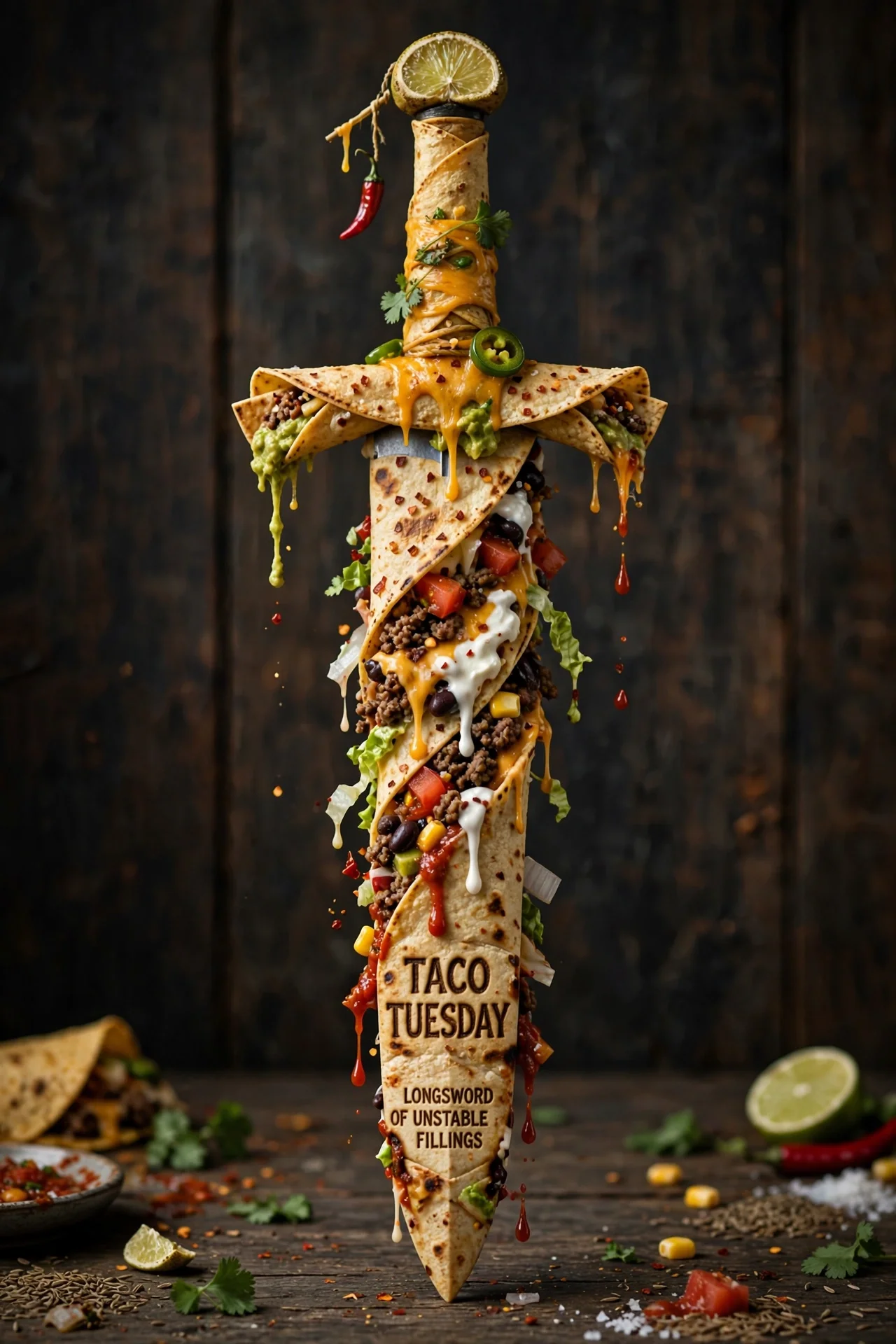
The Taco Tuesday Longsword of Unstable Fillings is a +1 magical longsword shaped like an enormous folded tortilla. Whenever its wielder scores a critical hit, the blade ruptures and sprays enchanted salsa into the target’s face. The creature is briefly blinded and must succeed on a DC 15 Constitution saving throw or lose control of its feet to an irresistible salsa rhythm.
This weapon is strongest in the hands of a durable martial character who makes several attacks, stays close to dangerous enemies, and can exploit the brief opening created when the weapon’s fillings finally become unstable.
Listen, laddie.
There are enchanted blades forged beneath mountains, swords blessed by forgotten gods, and weapons quenched in the blood of ancient dragons.
Then there is this thing.
The Taco Tuesday Longsword of Unstable Fillings is a curved magical blade resembling a giant folded tortilla. Its outer shell is warm, crisp, and suspiciously resistant to rain. Glowing cheese leaks from the fuller. Lettuce clings to the guard despite every attempt to remove it.
Nobody knows who forged it.
Nobody knows why it remains fresh.
Nobody agrees on whether the sour cream is part of the enchantment or merely a maintenance problem.
What everyone does agree upon is that the weapon becomes extremely dangerous when its wielder lands a perfect strike.
On a critical hit, the blade’s unstable fillings burst outward in an enchanted spray of searing salsa. The target is blinded long enough to create an opening, and creatures unable to withstand the weapon’s rhythmic magic begin dancing uncontrollably.
It is ridiculous.
It is disruptive.
And in the hands of a competent martial character, it is far more useful than it has any right to be.
Magic Weapon Statistics
Taco Tuesday Longsword of Unstable Fillings
Taco Tuesday Longsword of Unstable Fillings
Weapon (longsword), rare (requires attunement)
You gain a +1 bonus to attack and damage rolls made with this magical weapon.
The longsword deals 1d8 slashing damage when wielded in one hand or 1d10 slashing damage when wielded with two hands.
Unstable Fillings. When you score a critical hit with this weapon, enchanted salsa erupts from the blade. The target takes an additional 1d6 fire damage and is blinded until the start of your next turn.
The target must then succeed on a DC 15 Constitution saving throw or become overwhelmed by irresistible rhythmic magic until the start of your next turn. During that time, the creature cannot take reactions, its speed is halved, and it must spend at least 10 feet of movement dancing if it is able to move.
A creature that is immune to the charmed condition is immune to the dancing portion of this effect but is not automatically immune to the blindness or fire damage.
The weapon’s critical-hit effect can activate only once per turn.
Why This Weapon Is More Than a Joke
The first temptation is to treat the Taco Tuesday Longsword as a comedy item.
That is understandable.
It looks like dinner.
It attacks people with salsa.
It can force an ogre to dance in the middle of a battlefield.
But its actual strength comes from combining three useful effects inside one critical hit:
- Additional fire damage
- Temporary blindness
- Reduced movement and denied reactions on a failed save
The extra damage is pleasant, but it is not the main prize.
Blindness can make the target’s attacks less reliable while giving other creatures a better opportunity to strike it. Preventing reactions can also allow nearby allies to reposition without suffering the usual punishment for leaving an enemy’s reach.
The dancing effect halves the target’s speed and forces part of that movement to be wasted. Against a mobile enemy, bodyguard, skirmisher, or creature trying to escape, that can be far more valuable than another die of damage.
This is the same lesson explored in When Doing Less Damage Actually Wins You More Fights . A weapon does not need to produce the largest possible number if it creates an opening the entire party can exploit.
Position, timing, and target selection frequently matter more than raw weapon statistics. The Taco Tuesday Longsword rewards a player who understands that principle, even if the principle arrives covered in coriander.
Who Should Wield the Taco Tuesday Longsword?
The weapon is usable by any character proficient with longswords, but some classes benefit from it more naturally than others.
Fighter
The Fighter is the most dependable user.
Fighters make several attacks, remain effective in close combat, and can build around Strength without becoming fragile. More attacks mean more opportunities to score a critical hit, which means more chances for the enchanted fillings to become violently relevant.
A sword-and-shield Fighter can use the weapon as part of a defensive frontline configuration. The +1 bonus improves accuracy and damage, while the critical effect can weaken an enemy threatening the party’s more vulnerable members.
Players who want a broader understanding of the weapon’s ordinary battlefield role should read A Complete Guide to Longsword Combat in D&D 5e and Pathfinder 2e .
Paladin
The Paladin is another excellent choice.
Paladins already value critical hits because a critical strike can multiply the damage dice committed through Divine Smite. Adding fire damage, blindness, and battlefield disruption turns an already memorable hit into a full tactical event.
However, do not spend every spell slot simply because the sword begins leaking salsa.
First decide whether the target is dangerous enough to deserve the additional resources.
Ranger
A Strength-based Ranger can use the weapon effectively, especially in a campaign involving close terrain, confined dungeons, or frequent fights against mobile enemies.
The Ranger benefits from effects that make quarry easier to pursue and prevent dangerous targets from slipping past the frontline.
Martial Bard
A weapon-using Bard may be the most thematically appropriate wielder.
The sword sings.
The target dances.
The battlefield becomes a deeply embarrassing musical number.
The Bard can also support the party after the critical effect lands, helping allies exploit the opening rather than treating the moment as a private performance.
How to Build Around the Taco Tuesday Longsword
Do not create a character who becomes useless whenever the weapon fails to score a critical hit.
The sword’s special ability should improve a sound martial build rather than replace one.
Prioritise Yer Attack Ability
Most wielders should prioritise Strength.
Strength improves attack rolls and damage with the longsword. It also supports Athletics, grappling, carrying capacity, and the other physical tasks expected from a frontline character.
A magical weapon cannot help if every attack misses.
Protect Constitution
The sword requires its wielder to remain close to the enemy.
Constitution improves hit points and helps a character survive the retaliation that normally follows hitting a dangerous monster with an exploding meal.
Choose Features That Increase Reliable Attacks
Extra Attack is naturally valuable because each additional attack creates another opportunity to land a critical hit.
Advantage is particularly useful because rolling more attack dice improves the chance of producing a natural 20.
Do not mistake that for permission to chase complicated critical-hit combinations at the expense of the whole character.
Build a reliable warrior first.
Let the salsa become a blessing rather than the only plan.
Players who are still connecting ability scores, equipment, background, and combat role can begin with How to Build a D&D 5e Character Step by Step .
How to Use the Weapon in Combat
Attack the Enemy Yer Party Can Exploit
The largest creature is not always the best target.
Look for an enemy whose blindness, lost reactions, or reduced movement would help several allies.
Good targets include:
- A bodyguard blocking access to a more dangerous enemy
- A skirmisher threatening the party’s spellcasters
- A creature preparing to flee
- An enemy controlling a doorway or narrow passage
- A powerful attacker whose next turn must become less reliable
- A creature surrounded by allies who can immediately punish the opening
This is why position, timing, and target choice matter more than weapon stats . The Taco Tuesday Longsword becomes powerful when the wielder strikes the correct enemy at the correct moment.
Call the Opening Out Loud
When the critical effect activates, tell the party what changed.
Do not merely announce that the monster is dancing.
Say:
“The ogre cannot take reactions. Move away now.”
Or:
“The captain is blinded until my next turn. Hit him while the opening lasts.”
Clear communication turns a funny effect into party-wide value.
For more guidance on acting quickly and clearly during combat, read Not Sure What to Do on Your Turn? Try These 7 Player Habits .
Do Not Wait for the Perfect Critical Hit
The critical effect is unpredictable.
Do not spend the entire battle attacking an irrelevant target because it would be amusing to make that particular creature dance.
Fight normally.
Hold the correct position.
Protect the party.
Choose meaningful targets.
Then, when the natural 20 arrives, exploit it properly.
Should Ye Use It With a Shield?
Usually, yes.
The longsword deals 1d8 damage in one hand and 1d10 damage in two hands.
The difference is small.
A shield provides a substantial defensive benefit, especially for a character expected to remain beside dangerous enemies.
Use the sword with a shield when:
- You are the party’s main frontline defender
- Several enemies are likely to attack you
- You must hold a narrow space
- A vulnerable ally needs protection
- The party lacks another durable character
Use the weapon with two hands when:
- You do not have a shield available
- Maximum defence is unnecessary
- Your other hand must remain free outside the attack
- The character concept strongly favours a two-handed stance
The weapon’s special effect does not become stronger when used with two hands.
Do not surrender useful protection merely because gripping the giant tortilla with both hands looks more dramatic.
Advice for Game Masters
Make the Weapon Funny Without Making It Useless
Comedy magic items often fail in one of two ways.
Either the item is mechanically useless and becomes forgotten after one joke, or the joke hides an effect so powerful that the item begins controlling every encounter.
The Taco Tuesday Longsword sits between those extremes.
It is a dependable +1 weapon with a powerful but unpredictable critical-hit effect. The wielder cannot activate the salsa whenever convenient, and the once-per-turn restriction prevents unusual multi-hit interactions from producing repeated eruptions during the same turn.
Describe the Critical Hit Properly
The first activation deserves a memorable description.
Mention the tortilla shell splitting along the blade, the glow building beneath the cheese, and the sudden explosion of impossible salsa.
Then describe the target’s feet beginning to move before the creature understands what is happening.
After the first few activations, keep the description shorter so the joke does not slow every battle.
Establish the Tone During Session 0
A weapon like this belongs naturally in a comedic campaign, tavern adventure, festival session, culinary one-shot, or world where strange magical craftsmanship is already established.
It may feel disruptive inside a campaign intended to remain solemn, tragic, or frightening.
Discuss the campaign’s tone before placing the weapon in the world. A proper D&D Session 0 gives the group a chance to decide how much comedy belongs beside the serious parts of the story.
Give It a Story, Not Merely a Chest
Do not place the sword inside a random treasure pile unless randomness is part of the joke.
Better origins might include:
- A retired adventuring chef who used it to defend a travelling kitchen
- A cursed cooking competition judged by a fire elemental
- A festival champion who disappeared after winning thirteen consecutive Tuesdays
- A magical restaurant whose kitchen staff secretly served an ancient salsa spirit
- A failed attempt to create an endlessly replenishing field ration
The sword becomes more memorable when the party earns it through an encounter built around its identity.
Find a Table Worth Serving It At
A weapon this absurd deserves a table where the group can laugh, commit to the scene, and still take the encounter seriously enough for the mechanics to matter.
Adventurers searching for a regular campaign space can explore the Tavern Network , a growing collection of tabletop cafés, local game stores, clubs, hobby venues, and community spaces from around the world.
Start with Top 7 Ways to Find a D&D Venue That Actually Supports Long Campaigns if yer group needs more than a table for one evening.
Groups deciding between different styles of venue can also compare casual community hubs and competitive play venues before choosing where the next campaign should live.
For Singapore adventurers, the Network also includes Pixels & Pieces Singapore , a 24-hour gaming café where an unstable tortilla blade may be unusual, but probably not the strangest thing discussed after midnight.
Common Mistakes With the Taco Tuesday Longsword
Building Only for Critical Hits
A critical hit is never guaranteed.
Do not sacrifice accuracy, defence, or ordinary usefulness merely to chase a spectacular activation.
Forgetting the Target Is Blinded
The failed Constitution save controls the dancing effect.
The blindness occurs when the critical-hit ability activates, whether or not the target succeeds on that save.
Forgetting the Effect Ends Quickly
The blindness and rhythmic disruption last only until the start of the wielder’s next turn.
Allies must exploit the opening immediately.
Attacking the Funniest Target Instead of the Best Target
Yes, making the necromancer dance is satisfying.
But if the ghoul beside the Wizard is the more urgent threat, hit the ghoul.
Turning Every Activation Into a Five-Minute Performance
The weapon should add energy to combat.
It should not stop the session while one player selects music, clears the furniture, and begins teaching the monster choreography.
The Tavernkeeper’s Verdict
A Ridiculous Blade With a Serious Opening
The Taco Tuesday Longsword of Unstable Fillings succeeds because the joke and the mechanics support each other.
The weapon is funny before combat begins.
It remains dependable when no critical hit occurs.
Then, when the natural 20 finally lands, it produces a sudden tactical opening the whole party can use.
Give it to a frontline character.
Keep Strength high.
Carry a shield when the party needs a wall.
Attack the enemy whose disruption matters most.
Tell allies when the target loses its reactions.
And never trust a magical weapon that claims its fillings are stable.
By Grabgar’s greasy apron, laddie, they never are.
Frequently Asked Questions
Questions About the Taco Tuesday Longsword
Need broader help with the Tavern? Visit the main Mike’s Tavern FAQ.
The Taco Tuesday Longsword is a rare +1 magical longsword requiring attunement.
When its wielder scores a critical hit, the target takes an additional 1d6 fire damage and is blinded until the start of the wielder’s next turn.
The target must also make a DC 15 Constitution saving throw. On a failure, it cannot take reactions, its speed is halved, and it must spend at least 10 feet of movement dancing if it is able to move.
Yes.
The blindness and additional fire damage occur immediately when the weapon scores a critical hit.
The Constitution saving throw applies only to the dancing effect, the reduced speed, and the loss of reactions.
The Fighter is the most dependable wielder because Fighters make several attacks, remain durable in close combat, and gain more opportunities to score critical hits.
Paladins are also excellent users because a critical hit can combine the weapon’s salsa effect with Divine Smite.
Strength-based Rangers and martial Bards can use the weapon effectively when their build supports close combat.
Yes.
The weapon requires attunement because it provides a permanent +1 bonus and applies several effects on a critical hit.
Requiring attunement also prevents the party from passing the sword between several characters whenever one of them expects to make more attacks.
No.
A creature immune to the charmed condition is immune to the dancing portion of the weapon’s effect.
It can still take the additional fire damage and become blinded unless it possesses a separate immunity that prevents those effects.
It is powerful, but its strongest effect depends on scoring a critical hit.
The wielder cannot activate the salsa effect whenever desired, the dancing effect allows a saving throw, and all temporary effects end at the start of the wielder’s next turn.
These limits make the weapon appropriate as a rare magic item in many D&D 5e campaigns.
The weapon works best for characters around levels 5 to 10.
At those levels, martial characters usually have enough attacks and durability to use the sword effectively, while the weapon’s temporary control effects remain meaningful without dominating every encounter.
A Game Master can introduce it earlier in a high-magic or comedic campaign, but should consider the strength of a permanent +1 weapon and automatic blindness on a critical hit.
No reliable scholar has confirmed that the weapon is edible.
Attempts to bite the blade are made against enchanted steel disguised as a tortilla shell and may result in broken teeth, wounded dignity, or an argument with the party’s healer.
Mike’s Tavern accepts no responsibility for adventurers who mistake magical equipment for lunch.
