There are charming bards.
There are clever thieves.
And then there’s Timber Tinkertom — the cheek-stuffin’, applause-earnin’, coin-vanishin’ menace who’s turned Mike’s Tavern upside down more times than a drunk dwarf on a wet stone floor.If you’ve ever wanted to play the underestimated player who wins the room before anyone notices what’s missing from their purse, lad… this one’s for you.
And let’s clear this up proper: Tinkertom is a Pathfinder character. Pathfinder supports Ratfolk as a playable ancestry. D&D does not include ratfolk in the standard Player’s Handbook. You can homebrew it, sure. But Timber Tinkertom? He’s built for Pathfinder tables.
“By Trickin’s Cursed Coin Purse…” – Mike on Tinkertom
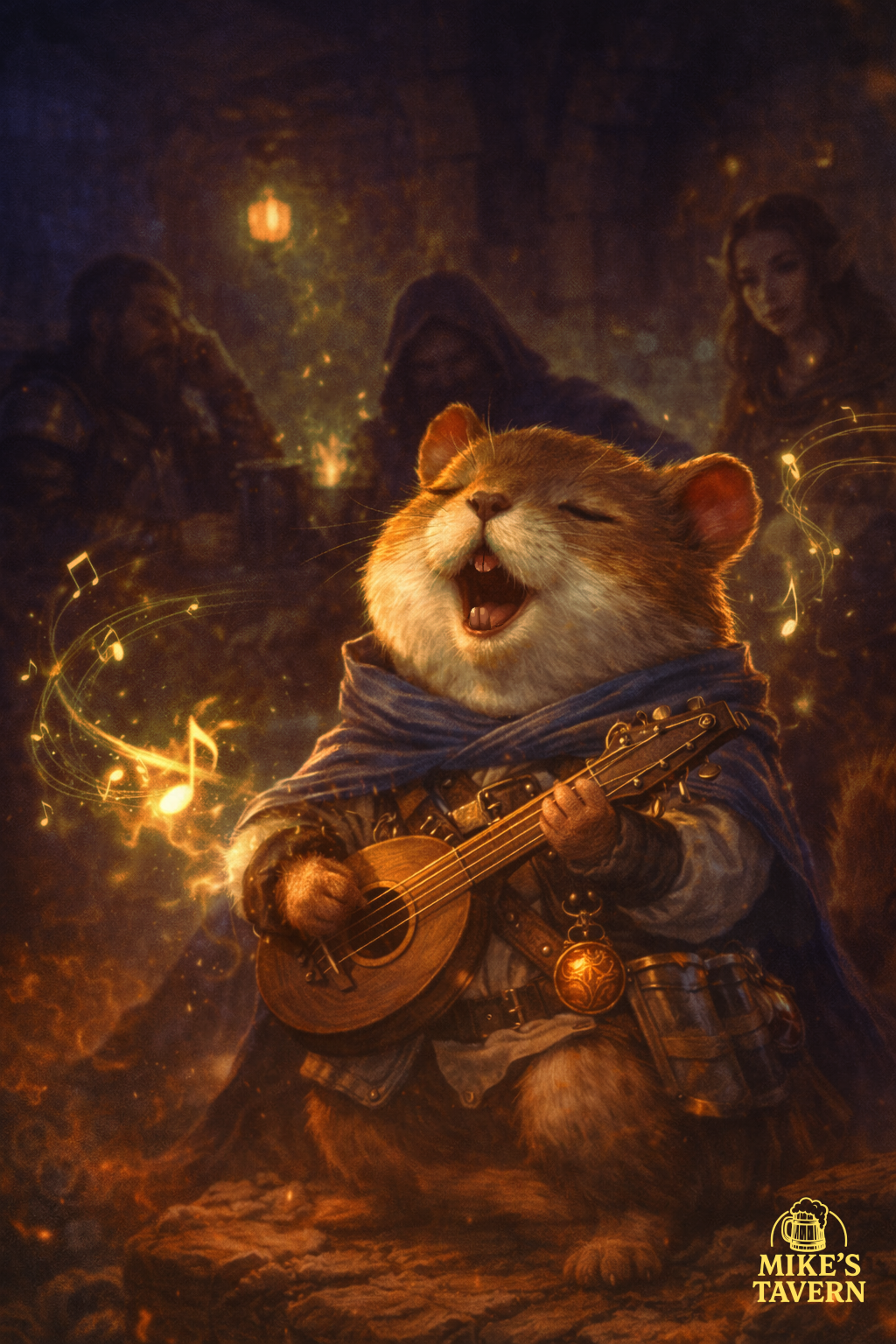
“Listen here, laddie. I’ve seen warlords, liches, and yellow-bellied milk-drinkers who couldn’t charm a goose with a sack of grain. But that little furball? He hops up on a table, gives one warm trill of a tune, and suddenly HALF THE ROOM’S PETTIN’ HIM LIKE HE’S SOME BLESSED TAVERN MASCOT.
And while they’re cooin’ and scratchin’ his ears, I can HEAR THE BLEEDIN’ COIN CLINKIN’ INTO THEM CHEEKS.
By Trickin’s cursed coin purse, he’s got the softest paws and the quickest fingers I’ve ever seen. I’m impressed. I’m outraged. And I’m checkin’ me own pockets every time he so much as blinks.”
Who Is Timber Tinkertom?
Role: Hamster Bard (Ratfolk reflavor)
System: Pathfinder Only
Primary Trait: Adorable distraction thief
Tinkertom is weaponized underestimation.
He does not dominate the room.
He inhabits it.
He sings warmly.
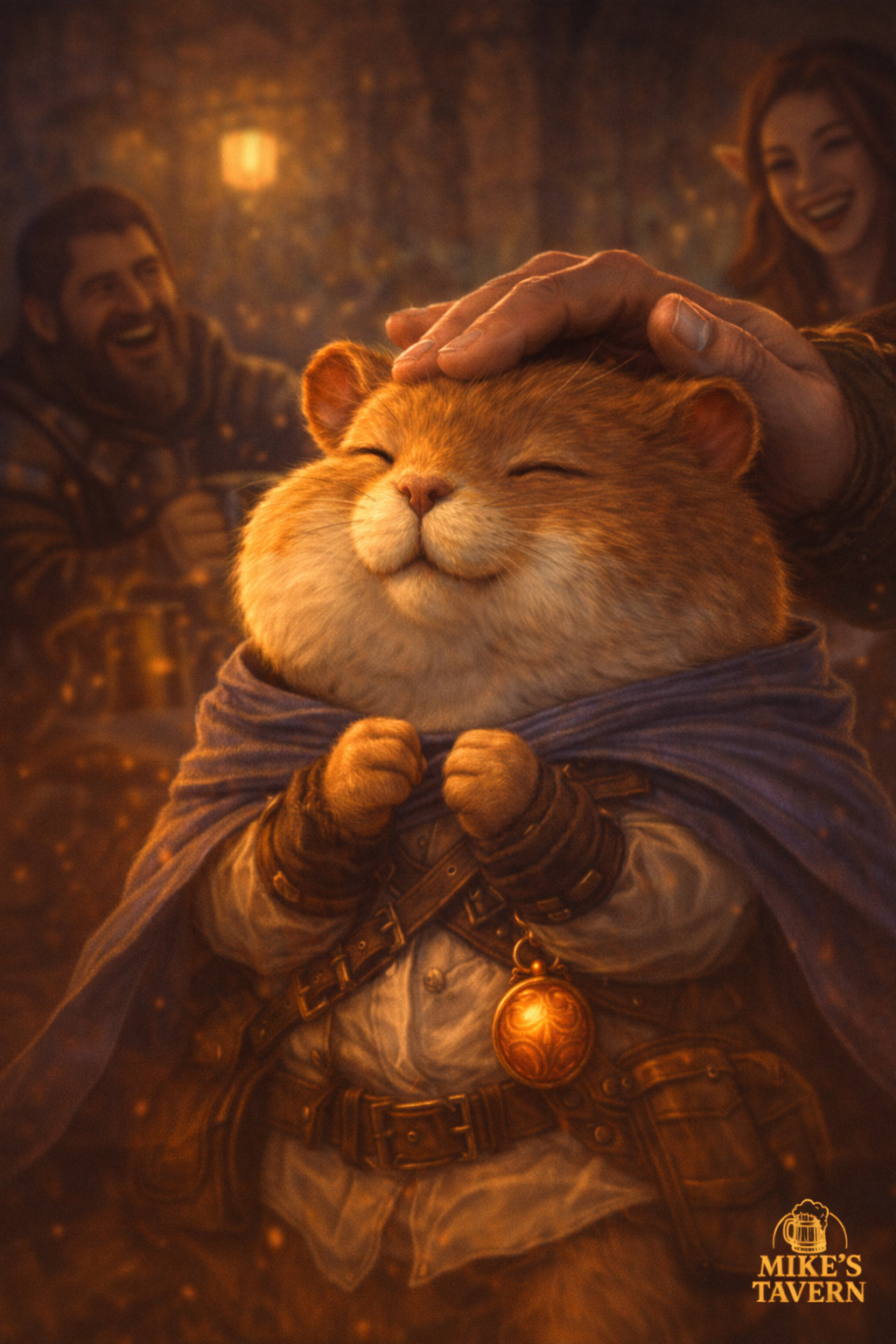
He accepts affection.
He smiles harmlessly.
And while attention gathers around him, his mind is calculating angles, exits, and opportunity.
Personality Profile: The Smiling Opportunist
Tinkertom thrives on emotional tempo.
He likes:
Warm tavern lighting
Applause that feels sincere
Being underestimated
Light physical affection
Clever wordplay
The sound of coin shifting unnoticed
He dislikes:
Being ignored
Loud brute-force personalities
Physical restraint
Cold environments
Being treated as incompetent
He isn’t malicious.
He’s opportunistic.
He steals less for wealth and more for proof — proof that charm outpaces steel.
If you’ve read The Strongest Character at the Table Is the One Who Listens, you already understand him.
Tinkertom listens.
He reads breathing patterns.
He notices posture shifts.
He knows when a fighter’s ego rises and when a wizard’s attention drifts.
And then he acts.
Core Attributes
No equipment breakdown. No armor math. Just the spine of the character.
Strength: Low
Dexterity: High
Intelligence: Above average
Wisdom: Moderate (emotionally aware)
Charisma: Extremely High
Tinkertom does not overpower.
He redirects.
In combat he:
Buffs allies
Distracts enemies
Uses sleight of hand
Controls morale
Avoids standing toe-to-toe
He tilts outcomes rather than dominating damage charts.
If your party’s encounters feel stiff or transactional, read Why Yer Epic Fights Keep Falling Flat — characters like Tinkertom inject tempo and narrative spark.
Why Play Tinkertom in Your Next Pathfinder Campaign?
Because some of you are charismatic… and still feel unseen.
You can speak.
You can joke.
You can perform.
And yet the barbarian roars louder.
The paladin gives bigger speeches.
The wizard explodes things more visibly.
Tinkertom is for the player who wants influence without dominance.
If you resonate with The Quiet Player’s Guide to Getting Noticed, this build fits you.
He teaches:
Presence without aggression
Attention through misdirection
Influence through warmth
Control without intimidation
But understand this clearly:
Charm without boundaries decays tables.
Before leaning too hard into trickery, read Why Your Party Keeps Falling Apart (And How to Stop Being the Reason).
Subtle disruption can become silent resentment if unmanaged.
The Pathfinder Performer’s Advantage – Don’t Play Cute, Play Calculated
If you’re building Tinkertom properly in Pathfinder:
Coordinate with your GM
Set boundaries on intra-party theft
Make your sleight-of-hand narrative, not punitive
Use charm to uplift morale, not fracture trust
Start with The Good Stuff That Keep the Tavern Standing to understand what stabilizes long-term campaigns.
Tinkertom shines when the table is secure.
He becomes dangerous when trust is thin.
The Psychological Archetype: The Underestimated Strategist
Tinkertom represents:
The underestimated player
The socially intelligent operator
The performer who masks calculation
The morale engine hiding behind fluff
He proves something important:
Control does not always roar.
Sometimes it squeaks softly while everyone’s laughing.
The Danger of Playing Him Poorly
If you turn Tinkertom into:
A constant party thief
A chaos gremlin with no accountability
A spotlight addict disguised as “cute”
You will erode trust.
Before that happens, read If No One Trusts Ya, That’s Not a Roleplay Choice — That’s a Problem.
Because once suspicion enters a table, it spreads faster than tavern gossip.
Enter the Tavern the Right Way
If you’re a Game Master trying to hold a table together without losing your sanity, sit down at The Game Master’s Table. That’s where the foundations are laid — encounter tempo, table psychology, morale management, and how not to let chaos quietly rot your campaign from the inside.
If your battles feel dramatic but unstable — like they could tip into resentment instead of momentum — then you’ll want the deeper layer inside The Game Master’s Table – Advanced Structure. That’s where we talk about pressure, pacing, and why some fights land while others fall flat even when the dice say they shouldn’t.
And if you’re wrestling with long-term table decay — players drifting, energy thinning, quiet comparison creeping in — then don’t ignore The Game Master’s Table – Long Campaign Stability. Because most campaigns don’t explode. They erode.
And lastly, if you’re new and wondering what kind of place breeds characters like Tinkertom, start with About Mike’s Tavern.
Got mechanical or culture questions? Visit the FAQ.
And if you’re designing your own underestimated mastermind, send it through the Contact page.
Timber Tinkertom — Pathfinder 2e Character Sheet
Ancestry: Ratfolk (Hamster Reflavor)
Class: Bard
Muse: Polymath (fits his adaptability and opportunism best)
Alignment: Flexible, leans toward Chaotic Neutral (with party loyalty)
Role: Social manipulator, morale controller, distraction specialist
Archetype Identity: Weaponized underestimation
LEVEL 1 TINKERTOM
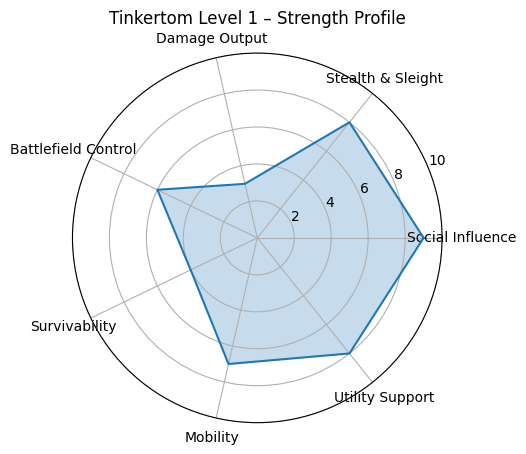
Core Concept at Level 1
At early levels, Tinkertom is not dangerous because of damage.
He is dangerous because of tempo.
He:
Controls social scenes
Disrupts early combat morale
Steals small items without destabilizing the campaign
Gains trust through charm
Ability Scores (Level 1)
After ancestry, background, class, and free boosts:
Strength: 8
Dexterity: 16
Constitution: 12
Intelligence: 12
Wisdom: 12
Charisma: 18
Charisma is king. Dexterity keeps him alive.
Ancestry (Ratfolk – Hamster Flavor)
Key Traits:
Small size
Agile
Excellent reflexes
Social adaptability
Ancestry Feat Suggestion (Level 1):
Something mobility or stealth-oriented (ratfolk typically excel at squeezing, climbing, or cooperation bonuses)
Flavor Adjustment:
Large cheek pouches (cosmetic but narratively functional)
Disarming body language
Tactile social strategy
Background
Street Performer or Charlatan
Grants:
Deception training
Performance training
Urban familiarity
This supports the tavern persona.
Class: Bard (Polymath Muse)
Why Polymath?
Because Tinkertom adapts.
He learns quickly.
He dips into multiple spell lists conceptually.
Bard Features at Level 1
Composition cantrips (morale boosts)
Occult spellcasting
Trained in Performance
Bardic cantrips for party buffs
Spell Themes at Level 1:
Charm
Fear disruption
Illusions
Minor crowd control
He does not blast.
He shifts advantage.
Skills (Level 1 Focus)
High priority:
Performance (Expert if possible)
Deception
Diplomacy
Stealth
Thievery
Society
Secondary:
Acrobatics
He is a battlefield ghost with a lute.
Equipment (Level 1)
Weapons:
Rapier (finesse, thematic)
Dagger (concealable)
Armor:
Studded Leather (light, flexible)
Gear:
Lute or small stringed instrument
Thieves’ tools
Hidden coin pouch
Cloak with interior pockets
Soft gloves
Belt pouch with minor stage props
Flavor:
Tiny silver bell attached to belt (intentionally misleading sound cue)
Polished copper coin he flips when thinking
Personality Hooks at Level 1
Quips:
“Oh, don’t mind me. I’m harmless.”
“Coin travels better in warmer pockets.”
“You’d be surprised what people give you when you smile.”
Behavior:
Makes eye contact longer than comfortable
Accepts head pats
Plays soft tunes while scanning exits
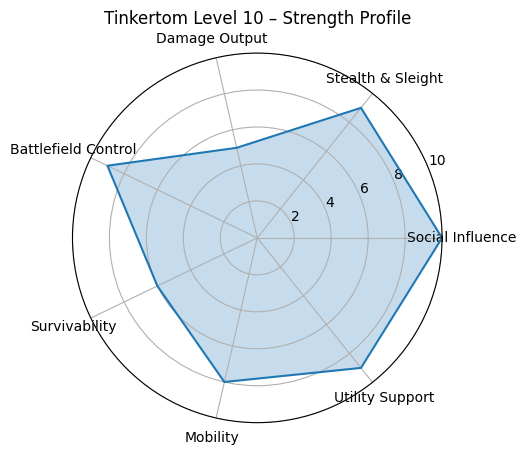
LEVEL 10 TINKERTOM
Now we’re looking at a different beast.
Level 10 Tinkertom is not cute.
He is dangerously competent.
Ability Scores (Level 10 Approximation)
With boosts at 5 and 10:
Strength: 8
Dexterity: 18
Constitution: 14
Intelligence: 14
Wisdom: 14
Charisma: 20
Charisma capped. Dexterity high. Survivability improved.
Class Features (Level 10)
By now he has:
Stronger composition spells
Sustained morale buffs
Advanced illusion control
Heightened enchantment spells
Battlefield debuffs
His action economy is tight and efficient.
He:
Opens with Inspire Courage equivalent
Follows with targeted control
Uses illusions to split enemy attention
Maintains distance
Skill Development (Level 10)
Performance — Master
Deception — Master
Thievery — Expert or Master
Diplomacy — Expert
Stealth — Expert
Acrobatics — Expert
At this stage:
He can:
Pickpocket mid-conversation
Bluff trained guards
Stage-craft entire distractions
Manipulate social conflicts
Feat Themes (Without Rule Text)
At Level 10, Tinkertom should focus on:
Enhanced compositions
Sustain efficiency
Social dominance feats
Skill feats for deception/stealth
Possibly magical versatility from Polymath
Avoid damage optimization.
Lean into control.
Equipment (Level 10)
Now we upgrade properly.
Weapons:
+1 Striking Rapier
Returning Dagger (hidden in sleeve)
Armor:
+1 Resilient Studded Leather
Magical Items:
Cloak enhancing deception or stealth
Instrument granting spell amplification
Ring that aids social skill checks
Boots improving mobility
Handy Haversack (where stolen goods “temporarily relocate”)
Utility Gear:
Master thieves’ tools
Smoke pellets
Fine silk rope
False coin purse (bait)
At level 10, he does not steal for survival.
He steals for leverage.
Combat Identity at Level 10
He controls:
Morale
Action denial
Fear effects
Confusion
Enemy positioning via illusions
He does not duel.
He orchestrates.
The barbarian thinks he’s winning.
The wizard thinks it’s their spell.
The GM knows better.
Social Presence at Level 10
In tavern scenes:
He can:
Turn a hostile crowd
Frame a rival
Diffuse a brawl
Shift blame elegantly
Extract secrets with a melody
He rarely lies loudly.
He implies.
Psychological Evolution
Level 1 Tinkertom:
Playful
Experimental
Light theft
Curious
Level 10 Tinkertom:
Surgical
Intentional
Politically aware
Knows exactly how much chaos a table can tolerate
Advanced Quips at Level 10
“It’s not theft. It’s temporary relocation.”
“Trust is a rhythm. Don’t rush it.”
“You’ll get it back. Probably.”
Campaign Hooks
Level 1 Hook:
Former street performer seeking patron
Owes a small debt
Wants recognition
Level 10 Hook:
Knows secrets about a noble house
Blackmail ledger hidden in cheek-lined scroll case
Has outgrown petty crime
Now trades influence
Final Note From Mike
“I tolerated him at level one. Annoyin’, but manageable.
Level ten?
By Grabgar’s hammer, I’ve seen generals sweat under less pressure.
He don’t swing axes.
He don’t throw fire.
He don’t shout.He smiles.
And somehow the room shifts.”
Explore More Tavern Goodness