
The Definitive Greatsword Guide, Part 1: Why Players Love Big Blades
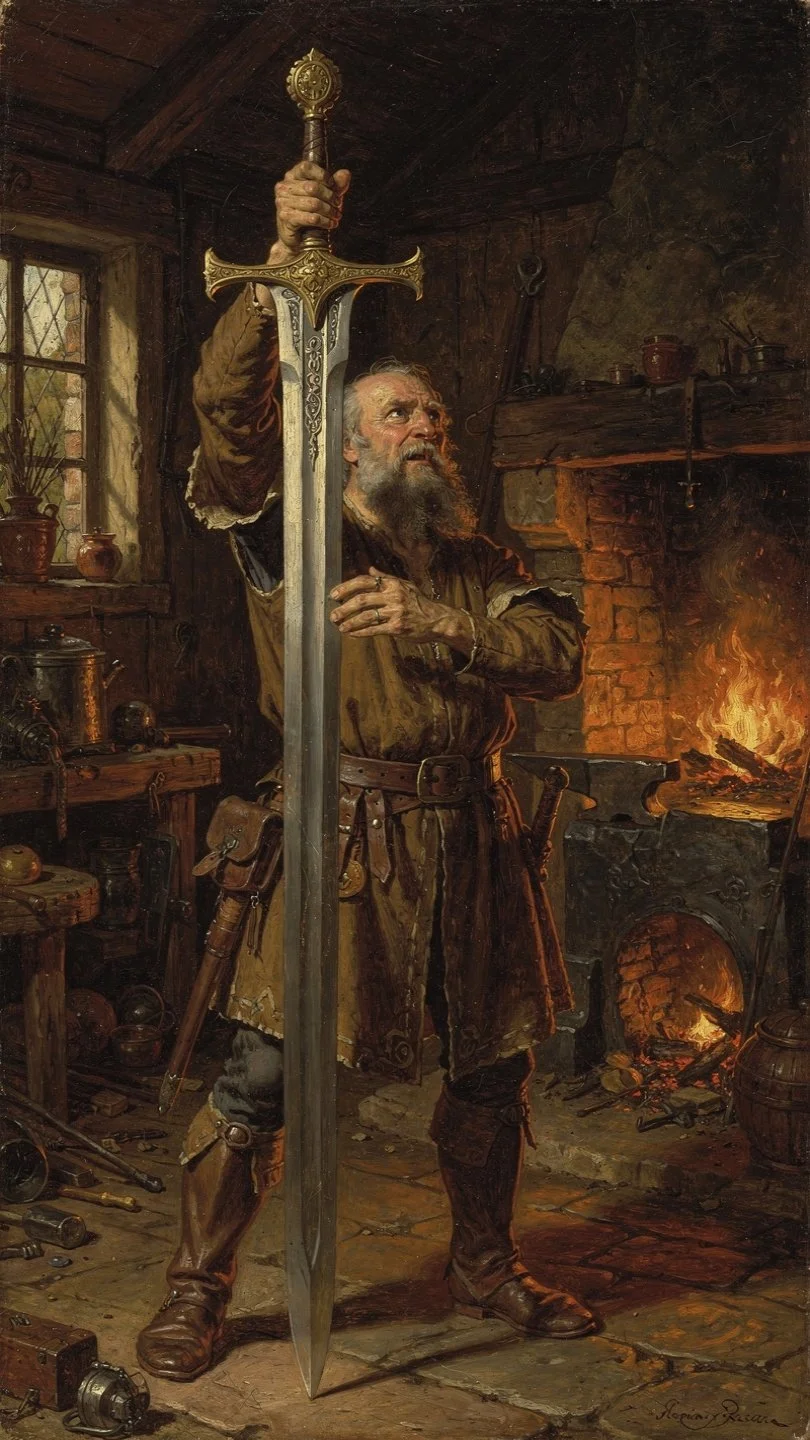
By Grabgar’s hammer, there are few sights at a table more honest than a player grinning like a fool because they finally got to swing the big blade.
Not a dagger. Not a rapier. Not some dainty little toothpick for pokin’ holes in goblins while whisperin’ poetry into the wind. A proper greatsword. Two hands on the grip. Shoulders set. Dice ready. Enemy in reach. The whole table knows what is about to happen.
And that, me lad, is the magic of it.
The greatsword is not loved only because it deals good damage. If all players cared about was numbers, every table would be full of identical builds, identical choices, and identical little damage engines wearing different hats. But that is not how people actually play. Players love big blades because they feel decisive. They feel brave. They make a character look like they mean what they say.
A greatsword tells the table something before the first attack roll even hits the tray.
It says, “I am going in.”
That is why this guide begins here, not with feats, class rankings, or perfect damage charts. Those are coming later. Part 2 will deal with the best classes and builds. Part 3 will get into feats, fighting styles, and damage. Part 4 will talk about using the weapon in real combat. But first, we need to understand why players keep reaching for the biggest blade on the weapon rack.
Because the greatsword is not just a weapon choice.
It is a character statement.
The Greatsword Feels Like Commitment
A greatsword character rarely feels accidental.
When someone picks a greatsword in D&D or Pathfinder, they are usually choosing a certain kind of fantasy. They want weight. They want presence. They want a character who does not drift around the edge of a fight waiting for the safest opening. They want someone who steps forward, takes the risk, and makes the enemy deal with them.
That matters more than many players realize.
In D&D, a greatsword uses two hands and deals 2d6 slashing damage. In Pathfinder 2e, the greatsword is also a two-handed martial weapon, built around a strong single damage die and heavy commitment. Different systems, different math, same emotional promise.
You give up the shield. You give up the free hand. You give up the image of the cautious duelist.
In exchange, you get a weapon that says, “When I hit, people notice.”
That trade is powerful because tabletop roleplaying games are not played in spreadsheets. They are played in imagination, memory, table laughter, near misses, bad decisions, and heroic recoveries. The greatsword sits right in the middle of that.
It gives players a simple, readable identity.
The sword is big. The danger is obvious. The purpose is clear.
For new players especially, that clarity is comforting. They may not understand every condition, reaction, feat chain, class feature, weapon trait, spell interaction, or tactical angle. But they understand this:
Stand near the monster. Swing the big sword. Protect the party if possible. Try not to die.
That is not shallow. That is accessible.
And accessible character fantasy is one of the reasons greatswords stay popular across editions, systems, and tables.
Big Blades Create Instant Table Recognition
Every table has seen this moment.
The GM describes the enemy. Maybe it is a troll dragging one broken arm across the stone. Maybe it is a skeletal knight in rusted plate. Maybe it is a demon halfway through tearing a door off its hinges. The wizard starts checking spell ranges. The rogue asks about shadows. The cleric looks nervous.
Then the greatsword player leans forward.
Not because they have solved the entire encounter. Not because they have the perfect plan. Because their role has become obvious.
They are the one who can meet the threat head-on.
That is a huge part of why players love greatswords. They create instant recognition at the table. Everyone understands the visual language. Big blade, front line, dangerous swing, serious intent.
This is also why greatsword characters often become memorable even when they are not perfectly optimized. A character does not need to produce the highest theoretical damage in the party to feel iconic. Sometimes they become unforgettable because they always step into the worst space first.
That is why a greatsword connects naturally to the kind of player wisdom behind Characters Who Aren’t Optimized But Are Unforgettable. The greatsword works because it gives a character a strong silhouette, both mechanically and emotionally.
You remember the warrior who blocked the tunnel.
You remember the paladin who raised the greatsword against the undead captain.
You remember the barbarian who missed twice, got mocked by the villain, then finally landed the hit that ended the fight.
The weapon creates moments that are easy to picture and easy to retell.
That is valuable.
A table does not only remember efficiency. It remembers shape, timing, risk, and payoff.
The Greatsword Makes Damage Feel Honest
There are many ways to deal damage in D&D and Pathfinder.
Some are subtle. Some are clever. Some rely on stacking bonuses, exploiting positioning, setting up conditions, triggering reactions, or coordinating multiple class features. Those can be excellent. Later parts of this series will talk about how smart greatsword players can use the same kind of tactical thinking.
But the greatsword has a special advantage.
Its damage feels honest.
You attack. You hit. You roll big damage. The table sees it happen.
That directness is satisfying. It gives the player a clear cause-and-effect loop. They took the risk of being close. They gave up defensive options. They committed both hands to the weapon. So when the damage lands, it feels earned.
This is especially true in D&D, where the greatsword’s 2d6 damage creates a smoother, more reliable damage curve than a single large die. It still feels big, but it avoids some of the emotional sting of rolling one miserable result on one die. In Pathfinder 2e, the greatsword’s heavy two-handed profile gives it a clean martial identity, especially for classes that can make one strike matter through accuracy, class features, or high-impact actions.
That does not mean the greatsword is always the best mathematical answer.
It is not.
Sometimes reach weapons control space better. Sometimes sword-and-board defense is wiser. Sometimes a polearm, bow, shield, spell, or finesse weapon solves the problem more cleanly.
But players do not only want “best.” They want the action to feel like the character.
That is where the greatsword shines.
It makes damage feel physical. It makes the attack feel like a swing, not a calculation. It gives the player the joy of throwing dice and seeing a battlefield choice turn into visible consequence.
And for many players, that feeling is worth more than squeezing out a tiny advantage somewhere else.
The Big Blade Fantasy Works Across Many Classes
One reason the greatsword stays popular is that it fits several heroic identities, not just one.
The Fighter with a greatsword feels disciplined. They are trained, steady, and dangerous because they know exactly how to use the weapon. They are not swinging wildly. They are reading openings, pressing advantage, and turning skill into force.
The Barbarian with a greatsword feels like momentum. Rage, impact, risk, and intimidation all flow naturally through the weapon. A barbarian holding a greatsword does not need much explanation. The image is already doing half the work.
The Paladin with a greatsword feels ceremonial and terrifying. It turns the character into a walking oath. The weapon becomes judgment, sacrifice, and duty. When a paladin raises a greatsword against a monster, the table understands the drama immediately.
In Pathfinder 2e, the Fighter loves accuracy and martial control. The Barbarian loves impact. The Champion can turn a heavy blade into a symbol of conviction. The Magus can use a big weapon to make a magically charged strike feel dramatic and dangerous. Different mechanics, same core appeal.
A greatsword is flexible because it supports both simple and advanced play.
A beginner can pick it because it makes sense.
A veteran can pick it because the tactical ceiling is higher than it first appears.
That distinction matters. A weapon can be easy to understand without being shallow. The best greatsword players eventually learn that the blade itself is only the beginning. Target choice, timing, movement, advantage, accuracy, and party support all matter.
That is why greatsword play pairs so well with the thinking behind The Difference Between Being Deadly and Being Reliable. A greatsword player who only chases big numbers may look impressive for one round. A greatsword player who knows when to hold position, when to pressure, when to finish, and when to protect the weaker backline becomes valuable every session.
The blade is big.
The brain still needs to work.
The Greatsword Is Not Just About Damage Per Round
Now listen here, lad, because this is where many players start chewing gravel.
A greatsword is not automatically good because it can produce high damage. Damage matters, yes. Nobody picks up a greatsword because they want to gently inconvenience a skeleton. But damage without judgment is just noise.
This is where newer players can get trapped.
They start asking only one question: “How do I make the number bigger?”
That question has its place. We will talk about feats, fighting styles, damage boosts, and build choices later. But if that becomes the only question, the character becomes fragile in a different way. The player begins measuring every turn by whether they achieved the biggest possible hit. Anything less feels like failure.
That is a fast path to frustration.
Greatswords are better understood as pressure weapons. They make enemies respect space. They punish openings. They turn one good hit into a major shift. They make the front line feel dangerous. They give allies room to work because enemies cannot simply ignore the person carrying the giant blade.
That is why this series will not treat the greatsword as a mindless damage stick. Mike’s Tavern has already warned against that kind of thinking in Why Chasing DPR Is the Fastest Way to Burn Out. The greatsword is fun because it can hit hard, yes, but it stays fun when the player understands that hitting hard is only one part of combat.
A missed attack can still shape enemy movement.
A threatening position can still protect an ally.
A delayed charge can still force the villain to react.
A greatsword player who understands pressure becomes more dangerous than one who only understands damage.
The Big Blade Oath
If ya are building a greatsword character, do not start with the numbers first.
Start with the promise.
Ask what yer character is saying by carrying that weapon. Are they reckless? Disciplined? Proud? Guilty? Protective? Looking for a glorious death? Trying to become strong enough that no one else has to stand in front?
Once that promise is clear, the mechanics become easier to choose.
For more weapon-minded thinking, wander through A Complete Guide to Longsword Combat in D&D 5e and Pathfinder 2e, then come back here ready to swing something heavier.
Big Weapons Make Players Feel Brave
There is also a simple emotional truth here.
Greatswords make players feel brave.
Not always smart. Not always safe. Brave.
That is important because tabletop games often ask players to do things they might hesitate to do in real life. Speak up. Take risks. Protect others. Make bold choices. Stand firm when the situation looks ugly.
A greatsword gives that bravery a shape.
It lets a shy player feel physically present in the fiction. It lets a cautious player experiment with boldness. It lets a tactical player create threat. It lets a dramatic player build scenes around sacrifice, challenge, rivalry, and last stands.
This is one reason big weapons are especially appealing in fantasy games. They externalize courage. The character’s courage becomes visible before they even act.
A rogue’s courage might be hidden in timing.
A wizard’s courage might be hidden in preparation.
A cleric’s courage might be hidden in endurance.
But a greatsword wielder’s courage is standing right there in both hands.
That does not make them better than other characters. It makes them legible.
The table can see what they are about.
The Greatsword Has Built-In Drama
A big blade also creates drama because every swing feels like a question.
Will it hit?
Will the enemy survive?
Was it worth giving up the shield?
Did the player choose the right target?
Can they hold the line after stepping forward?
That drama matters. Combat can become flat when players only think in terms of turns and numbers. The greatsword helps resist that flattening because the weapon naturally invites description. Even a normal attack can feel vivid if the table gives it room.
A greatsword scraping across stone.
A blade raised over one shoulder.
A two-handed swing that forces an ogre backward.
A desperate miss that leaves the fighter exposed.
A final hit that drops the monster before it reaches the wizard.
These are not complicated scenes, but they are memorable. They give combat pulse. They remind the table that a weapon is not just a line on a character sheet.
This is where Mike’s Tavern’s combat philosophy matters. A fight should not feel like a board meeting with dice. It should have fear, movement, consequence, and rhythm. If yer table keeps losing that feeling, When Combat Has Rules, Turns, and Numbers But No Pulse is worth reading alongside this series.
The greatsword helps because it is naturally cinematic.
But the player still has to use it with intent.
Why Players Keep Coming Back to the Greatsword
Players love greatswords because they combine four things very cleanly.
They are easy to understand.
They are satisfying to imagine.
They are mechanically respectable.
They create strong character identity.
That combination is rare. Some weapons are mechanically strong but visually plain. Some are flavorful but awkward. Some are tactically rich but intimidating for new players. The greatsword sits in a sweet spot. It is simple enough to pick up, strong enough to respect, and dramatic enough to remember.
That is why it keeps surviving edition changes, system shifts, optimization debates, and table trends.
The greatsword gives players permission to be direct.
In a hobby full of clever plans, hidden motives, social hesitation, and complicated rules, sometimes a player wants one clear thing.
A monster stands there.
A hero stands here.
The blade comes down.
Beautiful.
When the Love Becomes a Trap
Of course, the very reasons players love greatswords can also get them into trouble.
A player who loves the fantasy too much may charge every enemy.
A player who loves the damage too much may ignore defense.
A player who loves the heroic image too much may forget the party.
A player who loves the big moment too much may become frustrated when the dice refuse to cooperate.
That is why Part 1 has to end with a warning. Loving big blades is good. Trusting them blindly is not.
The greatsword is not a solution to every fight. It will struggle when enemies fly, kite, swarm, blind, restrain, outmaneuver, or punish melee attackers. It can also disappoint players who expect every turn to feel legendary.
A good greatsword player learns patience.
Sometimes the best move is not charging. Sometimes it is holding a doorway. Sometimes it is protecting the caster. Sometimes it is finishing the wounded enemy instead of chasing the dramatic duel. Sometimes it is accepting that the archer, wizard, rogue, or cleric has the better answer this round.
That does not make the greatsword weaker.
It makes the wielder wiser.
The strongest greatsword characters are not the ones who swing every chance they get. They are the ones who know when the swing matters.
For players who want to sharpen that instinct, What Veteran Players Stop Caring About and Why New Players Should Too fits beautifully here. Veteran players often stop obsessing over looking impressive every round. They start caring more about timing, teamwork, and whether the party survives the whole fight.
That is where greatsword play grows up.
The Real Reason Big Blades Endure
So why do players love big blades?
Because they make courage visible.
Because they make combat feel physical.
Because they give new players a clear role.
Because they give veteran players a familiar weapon with surprising depth.
Because they turn risk into identity.
Because when the table is quiet, the enemy is near, and the dice are waiting, few things feel better than gripping the big sword and saying, “I step forward.”
That is the heart of the greatsword.
Not just damage.
Not just optimization.
Not just fantasy art and oversized steel.
The greatsword endures because it lets players feel like the kind of hero who does not need to be subtle to matter. The kind who plants their feet. The kind who takes the hit if needed. The kind who makes the battlefield look at them.
And by me beard, there is still something glorious about that.
Pull Up a Chair Before the Next Swing
This is only Part 1 of the guide. Next, we get into the classes and builds that actually make the greatsword shine in D&D and Pathfinder.
If ya are new to the tavern, start with About Mike’s Tavern, check the FAQ, or send a raven through the Contact page if ya need to find the right shelf, guide, or weapon rack.
