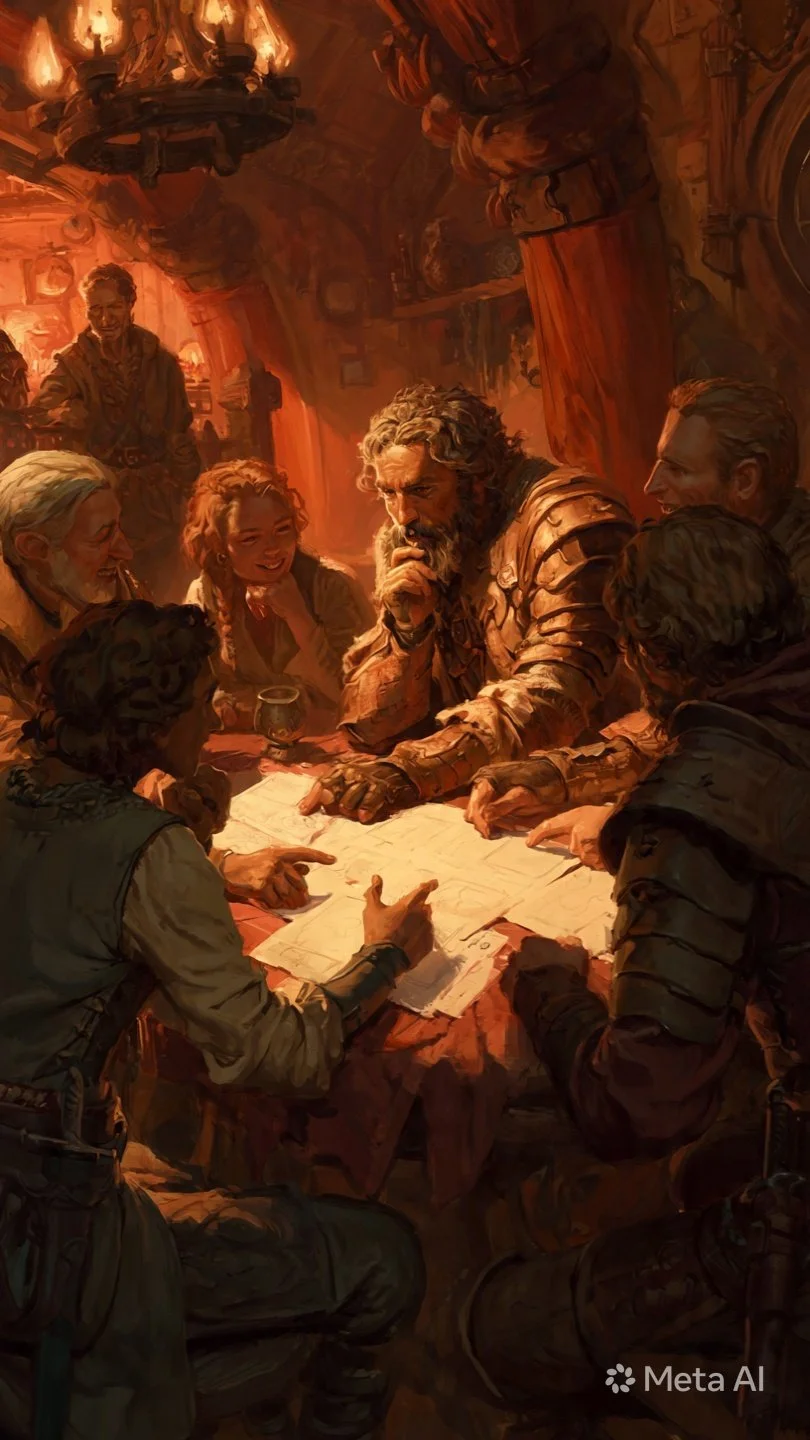
Listen, laddie. If yer Session 0 begins with everyone opening character builders while the Game Master mutters, “Alright, make whatever ya like,” then by Margann’s crusty beard, that is not preparation.
That is four people quietly constructing four different campaigns.
One player is building a knight for heroic fantasy.
Another is preparing a gunslinger for smoky steampunk streets.
A third expects political intrigue.
The fourth has created a goblin named Spoon who wants to collect hats and bite aristocrats.
Then the Game Master begins Session 1 with a bleak survival story about industrial pollution and class warfare.
Everyone technically attended Session 0.
Nobody actually used it.
The most dangerous Session 0 mistakes are not dramatic. They are omissions. A Game Master forgets to explain the tone, the players never discuss what they want, nobody agrees on attendance, and the campaign begins before the table understands what it is building.
The goal of Session 0 is not character creation.
The goal is alignment.
Mistake 1: Treating Session 0 as a Character-Building Workshop
Character creation is part of Session 0, but it is only one part.
A new Game Master may think the meeting has succeeded because every player leaves with a completed character sheet. Ability scores are assigned. Classes are selected. Equipment has been purchased.
Unfortunately, the Game Master still does not know whether the players want a serious campaign, a tactical campaign, a comedy, or a relaxed social game.
The players do not know whether the campaign is a sandbox, a linear adventure, or a deadly survival story.
Nobody has discussed attendance, table behaviour, house rules, player-versus-player conflict, or what happens during disagreements.
The characters are ready.
The table is not.
Players who need mechanical help can use How to Build a D&D 5e Character Step by Step, but the Game Master must keep Session 0 focused on the campaign as a shared experience.
Character building answers:
Who am I playing?
Session 0 must also answer:
What are we playing together?
Mistake 2: Arriving Without a Clear Campaign Pitch
The Game Master should arrive at Session 0 knowing what kind of game is being offered.
That does not mean every plot twist must be planned.
It means the GM should be able to explain:
The campaign’s genre
The central premise
The expected tone
The approximate level of danger
The balance between combat, exploration, and social play
The amount of player freedom
The kinds of characters that fit
The kinds of characters that will struggle
A weak campaign pitch sounds like this:
“It is fantasy. You will go on adventures.”
That describes almost every D&D campaign ever played.
A useful pitch sounds like this:
“You are members of a failing border garrison defending isolated settlements from monsters. The campaign will be serious but not hopeless, with frequent tactical combat, wilderness travel, and difficult decisions about which communities you can save.”
Now the players can make informed choices.
They know that a cheerful wandering baker might work.
They also know that a character who refuses to leave the capital probably will not.
For a fuller preparation structure, use How to Plan a D&D Session 0 Step by Step.
Mistake 3: Hiding the Real Genre
Imagine a player is invited to a fantasy campaign.
He pictures ancient ruins, enchanted forests, swords, castles, and dragons.
He spends days creating a traditional knight shaped by feudal loyalty and old legends.
Then Session 1 begins.
The city is filled with factories.
The guards carry firearms.
Airships cross the sky.
Mechanical servants clean the streets.
The campaign is steampunk.
There is nothing wrong with steampunk.
The problem is that the player did not agree to play it.
His disappointment is immediate because excitement has collided with misinformation.
He may still participate, but the Game Master has created unnecessary pressure. Now the GM must persuade a disappointed player to enjoy a campaign he would have approached differently if the genre had been explained honestly.
This is not a storytelling problem.
It is a communication failure.
Players should not discover the campaign’s basic identity after they have already invested in the wrong fantasy.
Mistake 4: Assuming Everyone Wants the Same Kind of Game
Players may all say that they want to play D&D while imagining completely different experiences.
One wants difficult combat.
One wants emotional character drama.
One wants to explore a large world.
One wants to socialise and laugh with friends.
One wants to build an extremely powerful character.
None of these desires is automatically wrong.
The mistake is assuming they will naturally coexist without discussion.
A Game Master should ask every player:
“What are the three things you most want from this campaign?”
“What makes you lose interest during a session?”
“How serious should the game feel?”
“How much character conflict do you enjoy?”
“What would make you excited to return every week?”
The answers reveal the table’s actual campaign.
A group does not need perfect agreement. It needs compatible expectations and deliberate compromise.
Mistake 5: Failing to Explain What the Game Master Needs
Session 0 is not only about player preferences.
The Game Master has needs too.
The GM may need players to make decisive choices.
The GM may dislike running evil parties.
The GM may want characters who care about the central conflict.
The GM may need reliable attendance because preparation takes several hours.
The GM may be comfortable improvising locations but need advance notice before players pursue complicated personal quests.
These requirements should be spoken plainly.
A Game Master who hides every need in an attempt to appear accommodating eventually becomes exhausted.
Then frustration begins leaking into the game.
Descriptions become shorter.
Preparation becomes less ambitious.
Player questions feel irritating.
Cancellations feel personal.
A healthy Session 0 allows the Game Master to say:
“This is the campaign I can run well, and this is what I need from you to run it.”
That is not selfishness.
That is sustainability.
The Alignment Bell
Before anyone completes a character sheet, pause and ask each person to finish this sentence:
“I believe this campaign is going to be about…”
Listen carefully.
If one player says political intrigue, another says dungeon exploration, and the Game Master says wilderness survival, the table is not ready to begin.
That is not a disaster.
That is Session 0 doing its job.
Clarify the campaign until everyone can describe roughly the same experience.
Then build characters.
Mistake 6: Avoiding Administrative Decisions
Some Game Masters avoid administrative discussions because they feel boring.
They would rather discuss kingdoms, villains, gods, and character backstories.
Unfortunately, campaigns are usually killed by ordinary problems.
The table should decide:
How long sessions last
How often the group plays
What happens when someone is absent
How much notice is expected for cancellations
Whether the group plays without missing members
Who controls absent characters
What happens during rules disagreements
How late someone can arrive before the game begins without them
Where campaign updates are posted
How scheduling decisions are confirmed
These decisions do not feel exciting.
Neither does repairing the same scheduling dispute every week.
If the table does not create a system during Session 0, the Game Master will be forced to invent one while people are already frustrated.
Mistake 7: Refusing to Discuss Authority
Every table needs to know who has the final say and when.
The Game Master normally has authority over the world and immediate rulings.
Players have authority over their characters and personal boundaries.
The group may share authority over scheduling, house rules, attendance expectations, and acceptable table behaviour.
Without this distinction, every disagreement becomes a struggle.
A player questions a ruling.
The Game Master feels challenged.
The player feels dismissed.
Other players begin choosing sides.
The game stops.
A simple agreement can prevent this:
The Game Master makes a temporary ruling during play. The group reviews the rule after the session and decides how it will work in the future.
That preserves momentum without preventing discussion.
Mistake 8: Letting Players Build Characters in Isolation
A party can contain diverse personalities without containing five strangers who have no reason to cooperate.
Every character should answer:
Why am I joining this group?
Why will I stay when the group struggles?
What do I contribute?
What behaviour will I not tolerate?
Which other character do I already know?
What shared objective connects us?
The phrase “My character would not work with these people” should be addressed before Session 1.
If the character cannot participate in the campaign, the character must change.
The Game Master should not be expected to perform narrative gymnastics every week to keep an intentionally uncooperative character attached to the party.
Mistake 9: Allowing One Player to Control the Session
A confident player can unintentionally dominate Session 0.
They answer first.
They propose the house rules.
They reject campaign ideas.
They pressure quieter players into accepting their preferences.
The table appears aligned because nobody openly disagrees.
Then Session 1 begins, and the quieter players slowly withdraw.
The Game Master should collect answers individually before opening the discussion.
Ask each player to speak.
Do not let the most experienced person define what everyone wants.
This matters especially when a player regularly interrupts or redirects other people’s moments. The patterns described in The Spotlight Thief: Players Who Interrupt Every Big Moment Without Realizing It often begin before the adventure does.
Mistake 10: Believing Skill Can Replace Preparation
A talented Game Master may believe they can improvise around mismatched expectations.
They cannot.
Matt Mercer of the famed Critical Role Series could not consistently satisfy a table where one player expected heroic fantasy, another expected steampunk comedy, and a third expected brutal survival if nobody had discussed those expectations.
Brandon Lee Mulligan could not protect a campaign from repeated no-shows if the group had never agreed on whether absent players caused a cancellation.
These famous Game Masters spend days preparing, planning and asking great questions.
Skill helps a GM respond to problems.
It does not make preventable pressure harmless.
A stressed, overloaded Game Master will eventually lose clarity. Preparation becomes reactive. Story decisions become attempts to satisfy whoever complained most recently.
The campaign stops moving with purpose.
It begins wobbling between conflicting demands.
Mistake 11: Promising Every Player Everything
A new GM may try to resolve differences by promising that every preference will receive equal attention.
There will be political intrigue, tactical combat, romance, horror, exploration, comedy, crafting, mysteries, and personal quests in every session.
That promise is impossible.
Alignment does not mean everyone gets everything.
It means everyone understands the campaign’s priorities.
A Game Master should be honest:
“This campaign will focus mainly on exploration and survival. There will be social scenes and occasional political plots, but they will not dominate the game.”
That clarity allows players to choose whether the campaign suits them.
It is better for someone to decline before Session 1 than remain disappointed for six months.
Mistake 12: Ending Session 0 Without Clear Agreements
A good discussion can still fail if nobody records the decisions.
Two weeks later, people remember different versions of what was agreed.
Create a short campaign summary containing:
The campaign premise
Tone and genre
Session schedule
Attendance rules
Character restrictions
House rules
Rules-disagreement procedure
Table boundaries
Communication expectations
Post it where everyone can access it.
Session 0 should produce more than conversation.
It should produce a shared operating system.
The Campaign Pressure Test
Before ending Session 0, ask:
“What is the most likely reason this campaign could fail?”
Let everyone answer honestly.
Possible responses may include:
Scheduling
Unreliable attendance
Different playstyle preferences
Slow decision-making
Rules arguments
Character conflict
GM burnout
Poor communication
Choose the two greatest risks.
Create a plan for each one.
When players struggle to make decisions, the Game Master can apply the habits in Players Won’t Make Decisions? Try These 6 GM Habits That Turn Hesitation Into Action.
The goal is not to predict every problem.
It is to prepare for the most likely ones.
Repairing a Bad Session 0
A weak Session 0 does not automatically doom the campaign.
Ignoring its consequences might.
If the campaign has already begun, call for an alignment meeting.
Say:
“I think we began playing before we clearly established what everyone wants and needs. I want to pause and make sure we are building the same campaign.”
Then discuss:
What everyone thought the campaign would be
What the campaign has actually become
What is working
What is creating pressure
What needs to change
Which compromises are realistic
Do not pretend the problem is only one difficult player.
Examine the structure first.
The group may discover that no one was given enough information to make a good decision.
Save the Campaign Before It Needs Rescuing
A campaign should not require emergency repairs during Sessions 1, 2, 3, 4, and 5 because the Game Master arrived at Session 0 without a plan.
The GM does not need a perfect presentation.
The GM needs clarity.
Know what you are offering.
Ask what the players want.
State what you need.
Identify where preferences match.
Discuss where compromise is possible.
Set the administrative rules.
Then create characters that belong inside the campaign everyone has agreed to play.
Readers who need the foundation first should revisit What Is a D&D Session 0? A Beginner’s Guide Before Your First Campaign.
Alignment Comes Before Adventure
Session 0 is not the waiting room before the real campaign begins.
It is the first act of the campaign.
It is where the group decides what it is creating, how it will operate, and what each person must contribute to keep it alive.
Character creation matters.
Alignment matters more.
A completed character sheet cannot repair a misunderstood genre.
A clever backstory cannot solve unreliable attendance.
A powerful build cannot protect a table from unresolved expectations.
The best Session 0 does not leave everyone merely ready to play.
It leaves everyone ready to play the same game.
Learn more about the purpose behind Mike’s Tavern, browse the Tavern FAQ, or contact the Tavernkeeper when your campaign needs a stronger foundation.
Questions to Ask Before Session 1
Can every player explain the campaign in roughly the same way?
Have I clearly described the genre, tone, and structure?
Did quieter players have space to state their preferences?
Have I explained what I need as the Game Master?
Does every character have a reason to cooperate?
Have we agreed on attendance, scheduling, and rules disputes?
Am I promising more than I can realistically deliver?
Did Session 0 create actual agreements, or did we only create characters?
More Tavern Goodness For Ya!