
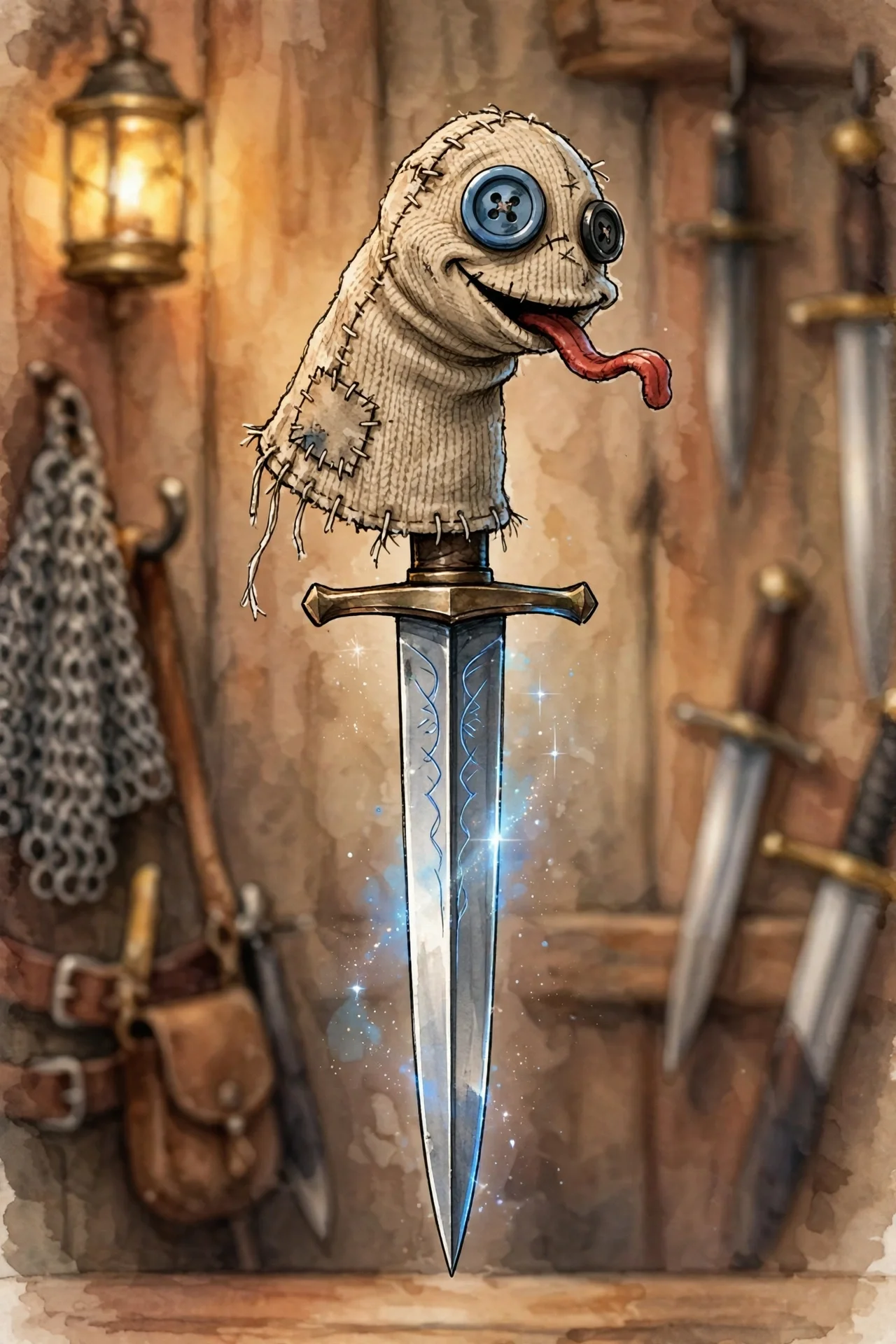
Tavern Armory
What Ye Need to Know
The weapon: Sock Puppet Dagger of Whispered Insults
Weapon type: +1 magic dagger
Rarity: Uncommon
Attunement: Not required
Best users: Rogues and multiclass characters with Sneak Attack
Combat role: Finesse damage, social disruption, and comic humiliation
When ye deal Sneak Attack damage with this dagger, its tiny puppet whispers a viciously personal insult. Once per turn, the victim must succeed on a DC 13 Wisdom saving throw or suffer disadvantage on the next Charisma ability check it makes before the end of its next turn. Creatures that cannot hear the puppet or understand any language are immune. The effect is narrow, but clever adventurers can use it to ruin a liar's bluff, break a battlefield command, or make a proud villain fumble the speech they rehearsed all week.
There are daggers forged in dragonfire. There are blades quenched in moonlit springs. Then there is this thing: a perfectly respectable steel dagger with a tiny, hand-stitched sock puppet fitted over its pommel.
The puppet has mismatched button eyes, a crooked red tongue, and the unnerving ability to discover exactly what its victim feels insecure about. It does not roar. It does not announce its magic. It leans close after the blade lands and whispers something so devastatingly specific that the victim briefly forgets how to be impressive.
The Sock Puppet Dagger of Whispered Insults is an original Mike's Tavern magic item for D&D 5e. Its joke is obvious, but its rules have a serious purpose. This is a reliable +1 finesse weapon with a small social-control rider. It rewards rogues for doing what they already do while creating unusual openings in fights built around deception, intimidation, negotiation, or command.
Magic Weapon Statistics
Sock Puppet Dagger of Whispered Insults
Formal D&D 5e Item Rules
Weapon (dagger), uncommon
You gain a +1 bonus to attack and damage rolls made with this magic dagger.
Whispered Insult. Once per turn, when you deal Sneak Attack damage to a creature using this dagger, the sock puppet whispers an insult that only nearby creatures can hear clearly. The target must make a DC 13 Wisdom saving throw. On a failed save, the target has disadvantage on the next Charisma ability check it makes before the end of its next turn. On a successful save, the target is unaffected.
A creature that cannot hear the puppet or cannot understand any language automatically succeeds on the saving throw. This feature is not a charm or fear effect, and immunity to the charmed or frightened condition does not prevent it. If the target makes no Charisma ability check before the duration ends, the effect expires unused.
The puppet cannot speak on command and offers no useful information. It knows only how to insult creatures struck by the dagger. If gagged, removed, or destroyed, it reappears intact around the pommel at the next dawn.
Small Blade, Precise Shame
Why This Ridiculous Dagger Works
The +1 bonus is the dependable part. Rogues care deeply about landing the one attack that carries Sneak Attack, so even a modest accuracy increase matters. The dagger remains useful against creatures that never speak, never negotiate, or possess confidence thicker than castle masonry.
The insult is tactical seasoning. Most combat rules do not require Charisma checks, so this weapon does not reduce a target's attacks, saving throws, spellcasting, or movement. That restraint is why the dagger can remain uncommon and require no attunement. When a Charisma check does appear, however, the puppet becomes memorable.
A disguised cultist may need Deception to preserve a false identity. A panicked captain may need Intimidation to rally wavering hirelings. A cornered noble may attempt Persuasion to bargain for escape. The penalty does not guarantee failure, but it lets the rogue interfere with the social machinery of an encounter without replacing the party's own face character.
Listen, laddie. Disadvantage is only valuable when a check is actually coming. The clever play is not stabbing every available ankle. It is recognizing the creature whose next sentence matters.
Who Should Hold the Sock
Best Wielders
Rogues
This is their weapon first. Sneak Attack activates the puppet, Dexterity supports the dagger, and Cunning Action helps the wielder move toward whichever loudmouth is about to influence the scene. A Swashbuckler suits the theatrical flavour, while a Mastermind or Inquisitive can exploit intrigue-heavy campaigns where Charisma checks occur during tense confrontations.
Fighter or Ranger Multiclasses
A character with at least one rogue level can use the dagger as a light off-hand option or a thrown opening attack. Extra Attack improves the chance of landing Sneak Attack if the first strike misses. Remember that the puppet triggers from Sneak Attack damage, not merely from hitting with advantage.
Bards with a Rogue Dip
A bard already understands how much one failed social check can change a scene. With a rogue level, the bard can embarrass an enemy before an exchange of threats or pleas, then let an ally answer with Persuasion or Intimidation of their own. It is not the strongest raw-damage arrangement, but it is splendid in a social campaign.
Build the Hand Behind the Puppet
Character-Building Guidance
Prioritize Dexterity. It improves attacks, damage, Armor Class in light armour, initiative, and the skills a rogue commonly uses. Constitution comes next if ye expect to fight close to the enemy. Wisdom remains useful for Perception and common saving throws, but it does not change the dagger's fixed DC.
Choose proficiencies that help identify the correct target. Insight tells ye who is bluffing. Perception spots messengers and commanders. Stealth helps the rogue reach them before they can speak. The dagger is especially satisfying on a character built to observe social pressure rather than merely generate it.
Do not build around increasing Charisma unless it already suits the character. The victim's penalty helps party interaction, but the wielder does not need to deliver the follow-up. In fact, good teamwork is the point. The rogue creates embarrassment, then the bard, paladin, warlock, or persuasive fighter exploits the wobble. For more on making that cooperation reliable, read the Tavern's guide to teamwork tricks that make ye the party member everyone trusts.
When to Let It Whisper
Combat Tactics for Weaponized Embarrassment
Mark the Creature Whose Words Matter
Before attacking, ask what each enemy is trying to accomplish. The ogre swinging a tree is probably not about to make a decisive Charisma check. The silver-tongued spy calling the guards corrupt might. The best target may be weaker than the largest threat because its voice controls witnesses, reinforcements, or morale.
Delay When the Scene Demands It
The effect lasts only until the end of the target's next turn. Strike shortly before the expected check, not three rounds before it. If turn order makes that awkward, consider whether preparing an attack is worth the risk. The Tavern's warning about the Ready action trap is useful here: a clever trigger can still cost ye an attack if the anticipated moment never arrives.
Call the Opening for Yer Allies
Tell the table when the target fails its save. The penalty applies only to the next Charisma ability check, so allies should not waste time guessing whether the puppet's magic took hold. Clear communication makes the weapon feel like party support rather than a private joke between rogue and GM.
Know When Damage Comes First
Never abandon a vulnerable priority target merely to chase a social penalty. A +1 dagger carrying Sneak Attack is still a weapon. If removing an enemy wins the fight, remove it. Position, timing, and target choice frequently matter more than the novelty printed on the item card, as the Tavern explains in its guide to choosing the right combat moment.
Finesse, Throwing, and Retrieval
The Dagger Still Has to Reach Them
Because a dagger has the finesse property, a rogue can use Dexterity for attack and damage rolls in melee. It is also light, which makes it suitable for two-weapon fighting when the character needs another chance to deliver Sneak Attack. Sneak Attack still occurs only once per turn, and the puppet likewise triggers only once per turn.
The thrown property creates a tempting way to insult a target across the room. It also creates a practical problem: the magic dagger is now lying beside the person ye just stabbed. Carry ordinary backup daggers and plan a safe retrieval. The puppet does not teleport back merely because its wielder regrets the throw.
A free hand also has value. It can manipulate an object, climb, draw a tool, or help the rogue escape an awkward position. Do not clutch a second dagger out of habit if the encounter demands mobility or interaction. This weapon rewards attention to the scene, and that includes what yer hands are doing.
Advice for the Game Master
How to Run the Puppet Without Letting It Run the Table
Introduce the dagger through a previous owner who is thoroughly sick of it. A captured burglar may offer it as payment. A fencing master may keep it locked inside a velvet case labelled only, "Do not encourage." A defeated court assassin may be feared for the blade while being personally mortified by its commentary.
Keep the insults short and specific to fictional details. Mock a hobgoblin officer's decorative plume, a necromancer's overwrought title, or a bandit's rehearsed growl. Avoid real-world identities, bodies, traumas, and anything a player has not agreed to make part of the humour. The puppet should embarrass characters, not people sitting at the table.
Call for Charisma checks only when the outcome is uncertain and meaningful. Do not manufacture a check every round merely to validate the item. Conversely, do not forget the effect when an enemy lies, bargains, performs, threatens, or tries to rally someone. If the fiction supports a check, let the dagger matter.
NPCs should react. Some become furious with the wielder. Some pretend they did not hear it. One terrifying villain might quietly compliment the puppet's technique. Those responses give the item a life beyond its modest mechanics.
Finally, establish the table's appetite for comic magic during Session 0. Humour feels strange before it feels natural for some players, and the advice in why roleplay feels strange before it feels fun can help a group give each other room without forcing a performance.
The Adventure Needs a Table
Find a Room Where the Puppet Can Be Heard
A whispered-insult weapon is funnier when everyone can hear the line and the target's response. If ye are choosing a public place for a long campaign, the quiet tavern versus loud game hall guide can help match the venue to the group's style. Ye can also explore the wider Tavern Network for places where tabletop stories can find a proper home.
Common Mistakes
Five Ways to Mishandle a Tiny Mouth
Triggering it on every hit. The insult requires Sneak Attack damage and can activate only once per turn.
Applying disadvantage to Charisma saving throws. The feature affects one Charisma ability check, not a saving throw or spell attack.
Assuming embarrassment means charm. Immunity to being charmed or frightened does not block the feature. Hearing and language are what matter.
Forcing checks to make the dagger relevant. The GM should request checks only when the fiction presents a real uncertainty.
Throwing the only magic dagger without a retrieval plan. A successful insult is poor consolation when the weapon lands behind the enemy line.
The Tavernkeeper's Verdict
A Good Dagger With Terrible Manners
The Sock Puppet Dagger of Whispered Insults belongs in intrigue campaigns, comic adventures, and any game where combat can spill directly into negotiation. Rogues gain a dependable +1 weapon. The party gains a narrow but satisfying way to undermine an enemy's social play. The GM gains a recurring character made from one sock and an unforgivable lack of restraint.
Use it to attack the right speaker at the right moment. Let allies exploit the opening. Do not expect it to solve every fight.
And if the lich suddenly stops monologuing, do not celebrate too quickly. The puppet may have simply said something worth thinking about.
Frequently Asked Questions
Questions About the Sock Puppet Dagger
Need broader help with the Tavern? Visit the main Mike's Tavern FAQ.
It is a +1 magic dagger. Once per turn, when its wielder deals Sneak Attack damage with it, the target makes a DC 13 Wisdom saving throw. On a failure, the target has disadvantage on its next Charisma ability check made before the end of its next turn.
No. It affects only a Charisma ability check, such as a check involving Deception, Intimidation, Performance, or Persuasion. It does not affect a Charisma saving throw, spellcasting ability check using another ability, or spell attack.
No. The insult is neither a charm nor a fear effect. A creature automatically succeeds only if it cannot hear the puppet or cannot understand any language.
A rogue uses it best because the signature effect requires Sneak Attack damage. Characters with a rogue multiclass can also activate it, provided the attack qualifies for Sneak Attack and uses this dagger.
No. Its +1 bonus and narrow social rider fit an uncommon item without attunement. A GM can therefore place it as early treasure without consuming a character's limited attunement capacity.
It works well from roughly 3rd level onward, once the party has established its basic abilities and magic weapons begin appearing. It remains useful later because accuracy matters, although its fixed DC 13 save becomes less reliable against powerful foes.
It can be gagged, removed, or destroyed temporarily, but it returns intact around the dagger's pommel at the next dawn. While gagged or absent, it cannot be heard, so Whispered Insult cannot affect a target.
No. A brief description such as "the puppet questions the duke's courage" is enough. Save spoken insults for moments when the table enjoys them, and keep the humour aimed at fictional details rather than real player sensitivities.
