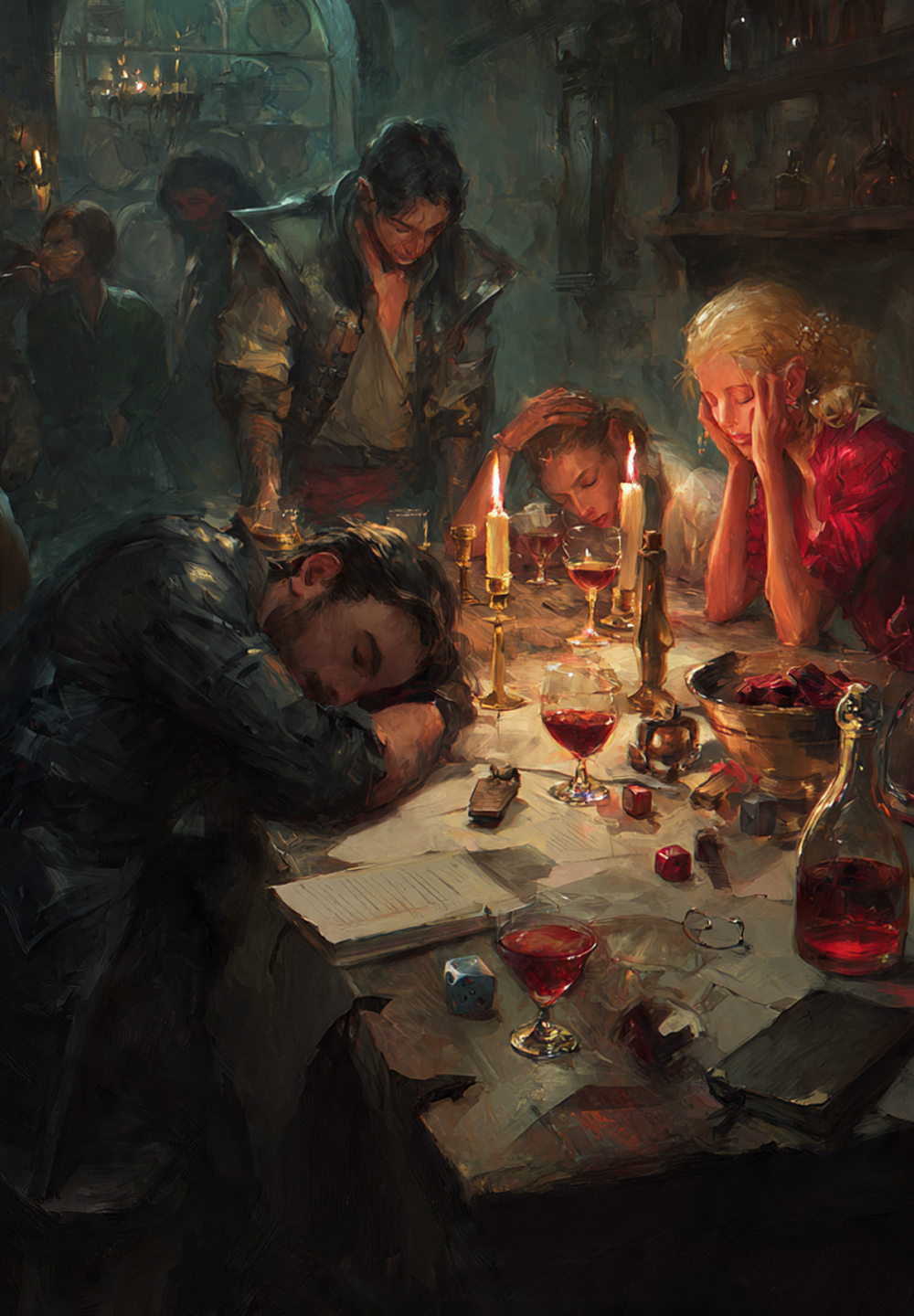
Do You Really Need a Session 0 in D&D?

Listen, laddie. Every few weeks, some confident adventurer stomps into me tavern and declares that his group does not need a Session 0.
“We already know how to play,” he says.
“We have all played together before,” says another.
“We just want to start the adventure.”
Then three sessions later, the paladin is trying to uphold a sacred oath in a campaign about cheerful grave robbery, the rogue has built a character who refuses to trust anyone, two players are arguing about whether stealing from party members is allowed, and the poor Game Master is clutching his notes like a drowning goblin clutching a barrel.
By Margann’s crusty beard, lad. The Session 0 was not delaying the campaign.
It was the thing that might have saved it.
Do You Actually Need a Session 0?
Almost every D&D campaign benefits from some form of Session 0.
That does not mean every group needs a four-hour formal meeting with printed documents, consent forms, character presentations, and seventeen varieties of coloured sticky notes.
A Session 0 can be a full evening.
It can also be a focused 45-minute conversation before character creation.
What matters is not the length or formality. What matters is that the group deliberately agrees on what kind of campaign it is about to play.
A Session 0 gives the players and Game Master a chance to establish:
The campaign’s premise and tone
Character creation expectations
Party relationships
Table rules and behavioural boundaries
Scheduling commitments
House rules
The balance between combat, exploration, and roleplay
What everyone hopes to experience
Players who have never encountered the idea should begin with What Is a D&D Session 0? A Beginner’s Guide Before Your First Campaign.
The important question is not simply, “Do we need a Session 0?”
The better question is:
What problems are we expecting the campaign to solve later that we could prevent by discussing them now?
The Campaign That Looked Fine
Imagine four friends preparing for a new campaign.
The Game Master describes it as a dangerous wilderness adventure. The players nod, make their characters, and begin playing.
One player creates a careful ranger who wants to map the wilderness.
Another creates a bard built around political manipulation.
The third creates a heavily armoured fighter expecting frequent tactical combat.
The fourth creates a comedic goblin whose main goal is stealing boots.
None of these characters are inherently bad.
The trouble is that each player has imagined a different campaign.
During the first session, the ranger carefully surveys the road ahead. The bard keeps asking for influential nobles. The fighter becomes impatient because no serious battle has started. The goblin steals a boot from an important guide.
Everyone laughs, but something has already shifted.
The ranger feels that the comedy is undermining the danger.
The bard believes the Game Master is ignoring social opportunities.
The fighter thinks the group is wasting time.
The goblin player believes the others are taking the game too seriously.
The disagreement does not explode immediately. Most campaign problems do not.
They accumulate quietly.
What Session 0 Actually Prevents
A Session 0 cannot guarantee that a campaign will succeed. It cannot make unreliable people reliable, solve every personality conflict, or predict every disagreement.
What it can do is expose incompatible assumptions before those assumptions become emotional injuries.
Without Session 0, players frequently mistake expectation differences for personal failures.
The player who wants tactical combat thinks the roleplayers are wasting time.
The roleplayer thinks the tactical player only cares about winning.
The serious player thinks the comedic character is disrespecting the story.
The comedic player thinks the serious player is controlling everyone’s fun.
These judgments become more severe because nobody named the original disagreement.
The problem was not necessarily selfishness.
The problem was that the group never decided what kind of game it was playing.
The Three Agreements Every Campaign Needs
A useful Session 0 creates three broad agreements.
1. The Campaign Agreement
The campaign agreement establishes what the adventure is fundamentally about.
Is this a heroic fantasy campaign?
A grim survival story?
A political conspiracy?
A relaxed monster-hunting adventure?
A chaotic comedy?
A table can contain several tones, but it still needs a centre of gravity. Players should understand what kinds of characters, decisions, and stories will fit comfortably inside the campaign.
The Game Master should also explain how much freedom the players will have. A sandbox campaign, a structured adventure path, and a tightly focused narrative campaign require different kinds of participation.
2. The Character Agreement
The character agreement ensures that the player characters have reasons to participate in the same adventure.
They do not need to like one another.
They do not need identical morals.
They do need enough compatibility to remain a functioning party.
Every player should be able to answer:
Why does my character join this group?
Why does my character stay when things become difficult?
What can my character contribute?
What behaviour would make cooperation impossible?
Players still working through character creation can use How to Build a D&D 5e Character Step by Step to turn a mechanical concept into a character who can survive an actual campaign.
3. The Table Agreement
The table agreement concerns the people sitting around the table rather than the characters inside the story.
It covers practical and social expectations such as:
How often the group plays
What happens when someone cannot attend
Whether players can use phones during play
How rules disagreements are handled
Whether player-versus-player actions are permitted
How spotlight time should be shared
What subjects should be avoided or handled carefully
This is where groups prevent many of their most destructive misunderstandings.
A player may believe interrupting is enthusiastic participation. Another experiences it as being repeatedly pushed out of the game.
A player may think hostile jokes are harmless banter. Another begins dreading every session.
When frustration cannot be discussed openly, it often becomes the kind of indirect hostility described in Why Passive-Aggressive Players Poison Campaigns Faster Than Openly Angry Ones.
The Campaign Alignment Check
Before anyone finishes building a character, ask each player to complete these three sentences:
I am hoping this campaign includes…
I would lose interest if every session became…
My character will help the party by…
These answers do not need to match perfectly.
They reveal whether the group’s expectations can coexist.
A player hoping for difficult combat can play alongside someone who loves character drama. The Game Master can deliberately create space for both.
The danger appears when one player wants a serious horror campaign while another wants to sabotage every tense scene for comedy.
Discovering that difference before the campaign begins is not failure.
It is successful preparation.
But We Have Played Together for Years
Groups of longtime friends still need Session 0.
Familiarity does not create automatic agreement.
In fact, experienced groups sometimes skip important conversations because they believe they already understand one another. They carry rules, habits, and assumptions from previous campaigns into the new one without checking whether those expectations still apply.
Your previous campaign may have encouraged chaotic characters.
The new campaign may depend on political trust.
Your last Game Master may have allowed extensive player-versus-player conflict.
The new Game Master may want a cooperative heroic party.
One player’s schedule may have changed. Another may want more roleplay than before. Someone who once enjoyed brutal horror may no longer want it at the table.
People change.
Campaigns change.
The agreement must therefore be renewed.
When Can You Safely Skip a Formal Session 0?
A group may not need a separate Session 0 meeting when all of the following are true:
The campaign is extremely short
The players already understand the premise
The characters are being created together
The group has recently discussed table expectations
The Game Master provides clear campaign information
Everyone has an opportunity to raise concerns
A one-shot played by an established group may only require a ten-minute briefing.
A long campaign with new players, complicated themes, unfamiliar rules, or major scheduling commitments deserves considerably more preparation.
Skipping the formal meeting is sometimes reasonable.
Skipping the conversation is not.
What Happens When You Ignore the Warning Signs?
Campaign misalignment usually decays in stages.
During the first few sessions, players accommodate one another.
Then small frustrations begin appearing as jokes.
The jokes become complaints.
The complaints become disengagement.
One player begins checking a phone.
Another stops writing a backstory because the story does not appear to matter.
Someone misses a session and discovers that they are not particularly disappointed.
Eventually, the campaign ends because “scheduling became difficult.”
Sometimes scheduling really is the problem.
Sometimes it is simply the explanation everyone finds easiest to say.
The deeper cause is that the table never built a shared reason to keep returning.
Game Masters trying to create that investment should also examine the ways players can be made to care about the world before the first major battle.
How to Run the Conversation Without Making It Awkward
Session 0 does not need to feel like a workplace meeting.
Begin with enthusiasm.
Describe the campaign you want to run and explain why you find it exciting. Then invite the players to help shape the experience.
Use direct questions:
“What part of this campaign interests you most?”
“How serious or comedic should the game feel?”
“Are there character concepts that would struggle to cooperate?”
“How should we handle disagreements during play?”
“What would make this campaign worth protecting for the next year?”
The Game Master is not interrogating the players.
The group is building its operating agreement.
For a complete process, follow How to Plan a D&D Session 0 Step by Step.
Session 0 Is Not a Contract Carved in Stone
The campaign’s first agreement should be revisited.
After three or four sessions, ask:
“Is the campaign feeling like what we discussed?”
“Does anyone need more or less of something?”
“Are any character dynamics becoming difficult?”
This follow-up catches problems that the group could not predict before play began.
A healthy table does not treat adjustment as an admission of failure. It treats adjustment as maintenance.
Tavern roofs leak.
Armour straps loosen.
Campaigns drift.
Wise adventurers repair small problems before the entire structure collapses on someone’s head.
Keep the Fire Burning
A Session 0 is not administrative clutter standing between the players and the adventure.
It is where the adventure becomes shared.
You do not need a perfect agenda. You do not need to predict every possible conflict. You simply need enough honesty to establish what the group is building and what each person must contribute to keep it standing.
The best campaigns are not held together by rules knowledge, impressive character builds, expensive miniatures, or the Game Master’s preparation alone.
They survive because the people around the table understand what they owe one another.
That is the real purpose of Session 0.
Learn more about the philosophy behind Mike’s Tavern, visit the Tavern FAQ, or contact the Tavernkeeper when there is a tabletop problem worth dragging into the light.
Questions to Ask Yourself Before the First Session
Have I clearly explained the campaign I intend to run, or am I expecting the players to guess?
Do the characters have strong reasons to cooperate after the first adventure ends?
Have we discussed the behaviours that could make someone stop enjoying the table?
Am I avoiding Session 0 because it is unnecessary, or because I am uncomfortable leading an honest conversation?
What disagreement is most likely to appear during this campaign?
What can we decide now so that we do not have to repair it after someone has already been hurt?
More Tavern Goodness For Ya